
Best Apps for Anxious Attachment (2026)
Short answer: choose an app that helps you practise new responses, not one that only tracks how you feel. Anxious attachment eases through small, repeated experiences of calming yourself and acting differently, so the best apps teach the pattern and then give you something to try in real life.
- For attachment-specific tools: Pali, Attached and Olively are all built around attachment.
- You are single, dating or just out of a relationship: Pali is the most individual-first of the three.
- You want partner-aware tools: Olively lets you add a partner profile without them installing the app.
- Mainly anxiety and sleep, not the pattern: Headspace or Calm help, though they are not attachment apps.
We make Pali, so read our take with that in mind. We have tried to be concrete about where the other apps fit better.
Apps for anxious attachment compared (2026)
| App | Best for | Main tools | Price model |
|---|---|---|---|
| Pali | Individual attachment work, whether you are single, dating or partnered | Attachment courses incl. Earned Security, AI coach, journaling, real-life experiments | 7-day free trial, then from 7.99 euro a month |
| Attached | Daily attachment exercises with AI journal analysis | AI coach, journal pattern analysis, personalised meditations, attachment score dashboard | 7-day free trial, then $12.99 a month or $99.99 a year |
| Olively | Attachment work with a partner in mind | Attachment quiz and profile, partner profile, text suggestions, guided programs, AI coach | Free quiz, subscription for the full app |
| Headspace, Calm | The anxiety and sleep around it | Meditations, breathing, sleep content | Subscription after a free trial |
| Journaling apps (Day One, Stoic) | Self-guided reflection | Journal, prompts | Free tiers, paid upgrades |
Prices and features change, so confirm the details in your app store before subscribing.
What features actually help anxious attachment?
Anxious attachment is a learned pattern, so the apps that help most are the ones that support relearning. Look for tools that build a pause between the trigger and your response, and that grow a sense of safety inside yourself rather than only in the relationship.
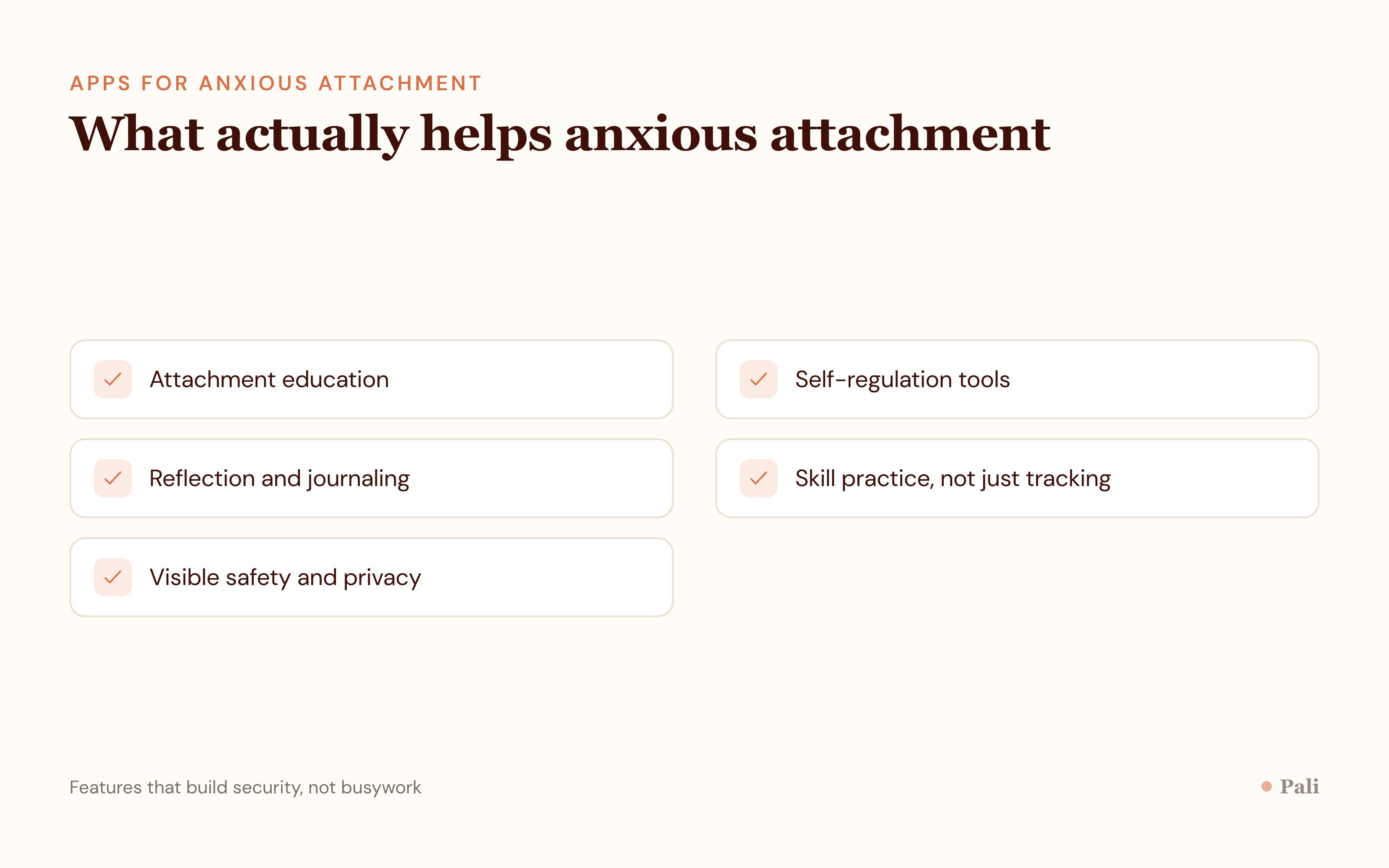
- Attachment education. Content that explains your style so you can recognise the loop. Our guide to anxious attachment covers the basics.
- Self-regulation tools. Grounding and breathing you can reach for when the alarm fires, for example when a text goes unanswered.
- Reflection and journaling. A place to name feelings and spot patterns over weeks, not just days.
- Skill practice, not just tracking. Prompts that ask you to try a new response in real life, then reflect on how it went.
- Visible safety and privacy. Clear crisis resources and honest data handling, which matters in this sensitive space.
The apps in more detail
Pali: individual-first attachment work
Pali is a relationship coach built on attachment theory, CBT and ACT. Its Your Attachment Style course helps you recognise your pattern, and Earned Security turns the work into short daily lessons: learn one idea, reflect on your own situation, try a small experiment in real life, then debrief. An AI coach and a journal fill the moments in between, like the hour after a message was left on read.
- Good fit if: you want to work on your own pattern first, whether you are single, dating, partnered or recovering from a breakup.
- Less good if: you want detailed charts and scores of your attachment over time.
- Price: 7-day free trial, then Premium at 7.99 euro a month or Unlimited at 12.99 euro a month, with cheaper annual plans.
Attached: daily exercises and journal analysis
Attached combines an AI coach with daily exercises, AI analysis of your journal entries, personalised meditations and a dashboard that tracks attachment scores and stress patterns. It covers anxious, avoidant and disorganised attachment and draws on CBT, DBT and ACT.
- Good fit if: you like measuring progress and want exercises chosen for you each day.
- Less good if: you prefer structured courses over a daily feed.
- Price: 7-day free trial, then $12.99 a month or $99.99 a year.
Olively: attachment with your partner in view
Olively starts with a free attachment quiz and a longer profile, then adds a partner profile (your partner does not need the app), attachment-aware suggestions for what to text, guided programs and an AI coach.
- Good fit if: you are in a relationship and want help reading your partner’s style as well as your own.
- Less good if: you are single and want to focus only on yourself.
- Price: free quiz, then a subscription for the full app.
Headspace, Calm and journaling apps
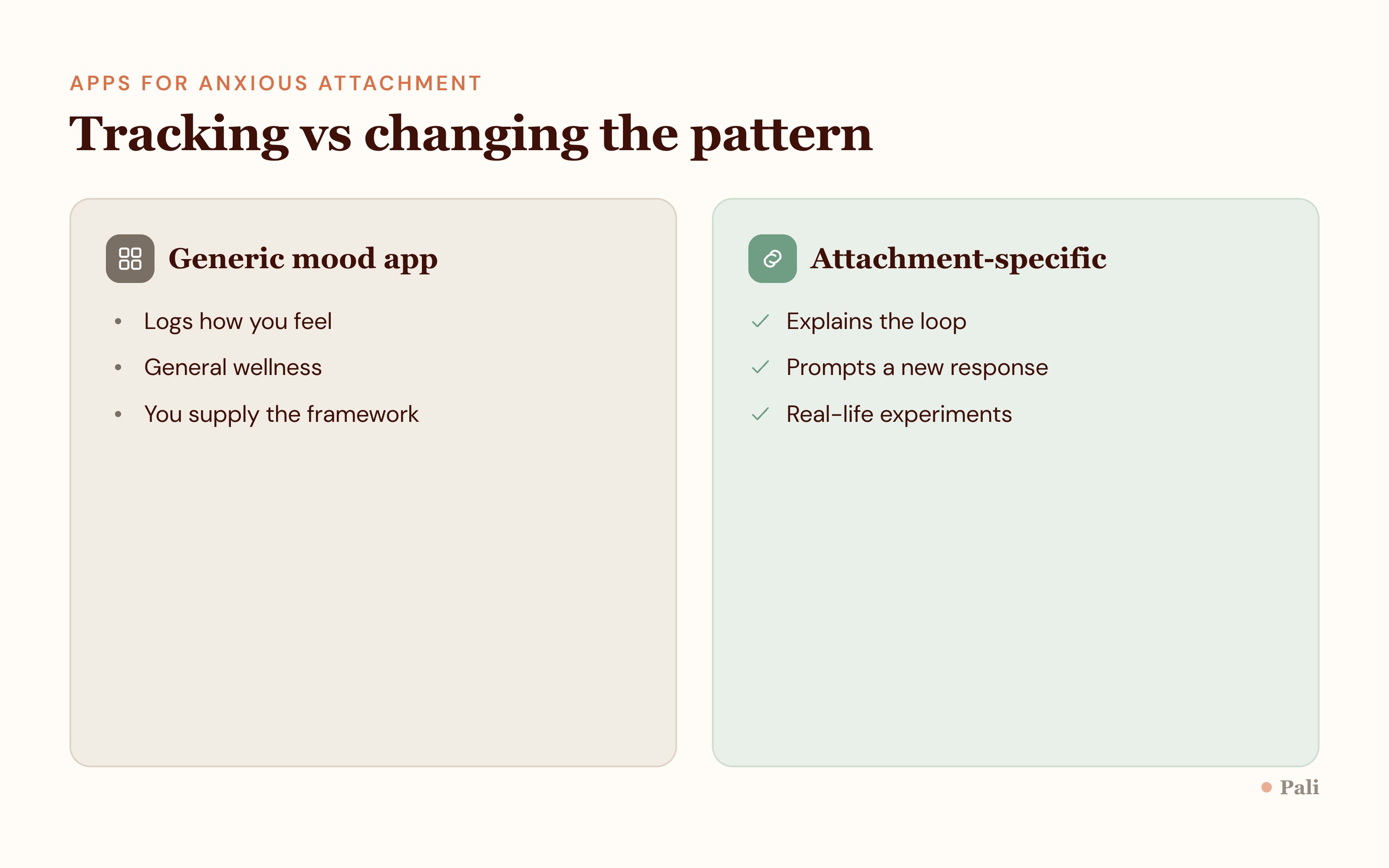
Mindfulness apps are strong for the anxiety and sleep that ride alongside anxious attachment, but they are not designed around it. Journaling apps like Day One and Stoic are good for reflection if you bring your own framework. Both work well as a supplement to an attachment-specific app.
How do I choose the right one?
Match the tool to your goal:
- You want calmer days. A mindfulness app helps, especially with overthinking at night.
- You want to shift the underlying pattern. Choose an attachment-specific app that prompts real-life practice.
- You are partnered and want to understand both of you. Pick a partner-aware app, though doing your own work first tends to make the joint work easier.
To see where you sit overall, read our guide to what your attachment style is, and for the full picture start with the complete guide to attachment styles. If breakups are part of your story too, see our roundup of the best apps for getting over a breakup.
An app supports growth, but it is not therapy. If anxiety is affecting your daily life, consider speaking with a professional as well.
Frequently asked questions
Is there an app specifically for anxious attachment?
Yes. Pali, Attached and Olively are all built around attachment rather than general wellness. Pali focuses on individual courses and real-life practice, Attached on daily exercises and journal analysis, and Olively on partner-aware tools.
Can an app really help with attachment style?
It can help meaningfully by teaching the pattern, prompting self-regulation and encouraging new responses in real life. Lasting change comes from the practice, with the app as a guide and reminder.
What is the best free app for anxious attachment?
Olively’s attachment quiz is free, and journaling and mindfulness apps have free tiers that help with the anxiety side. Most attachment-specific guidance, including Pali and Attached, runs on a 7-day free trial and then a subscription.
Do I need a couples app or an individual one?
If your aim is to understand and shift your own pattern, an individual-first app fits better. Couples apps focus on the relationship between two people rather than your personal attachment work.
Is there an AI app for anxious attachment?
Yes. Pali, Attached and Olively all include an AI coach. Look for one that also teaches skills and shows crisis resources, since reassurance alone can keep the anxious loop going.
Pali is designed for self-improvement and educational support. It is not therapy and is not a substitute for professional mental health care.