
Attachment Styles: The Complete Guide
There are four adult attachment styles: secure, anxious, avoidant, and fearful-avoidant. Your attachment style is the pattern of how you seek closeness, handle distance, and respond when a relationship feels uncertain. It forms early in life, it shows up most clearly under stress, and, importantly, it is not fixed. Most people are not locked into one box forever.
If you have landed here because something in your relationships keeps repeating and you are not sure why, that is a reasonable place to start. Understanding your attachment style will not explain everything about you, but it does tend to explain a lot about the moments that feel the hardest.
What are the four attachment styles?
Attachment styles describe how safe and how free you feel in close relationships. The four styles are best understood as patterns, not personality types.
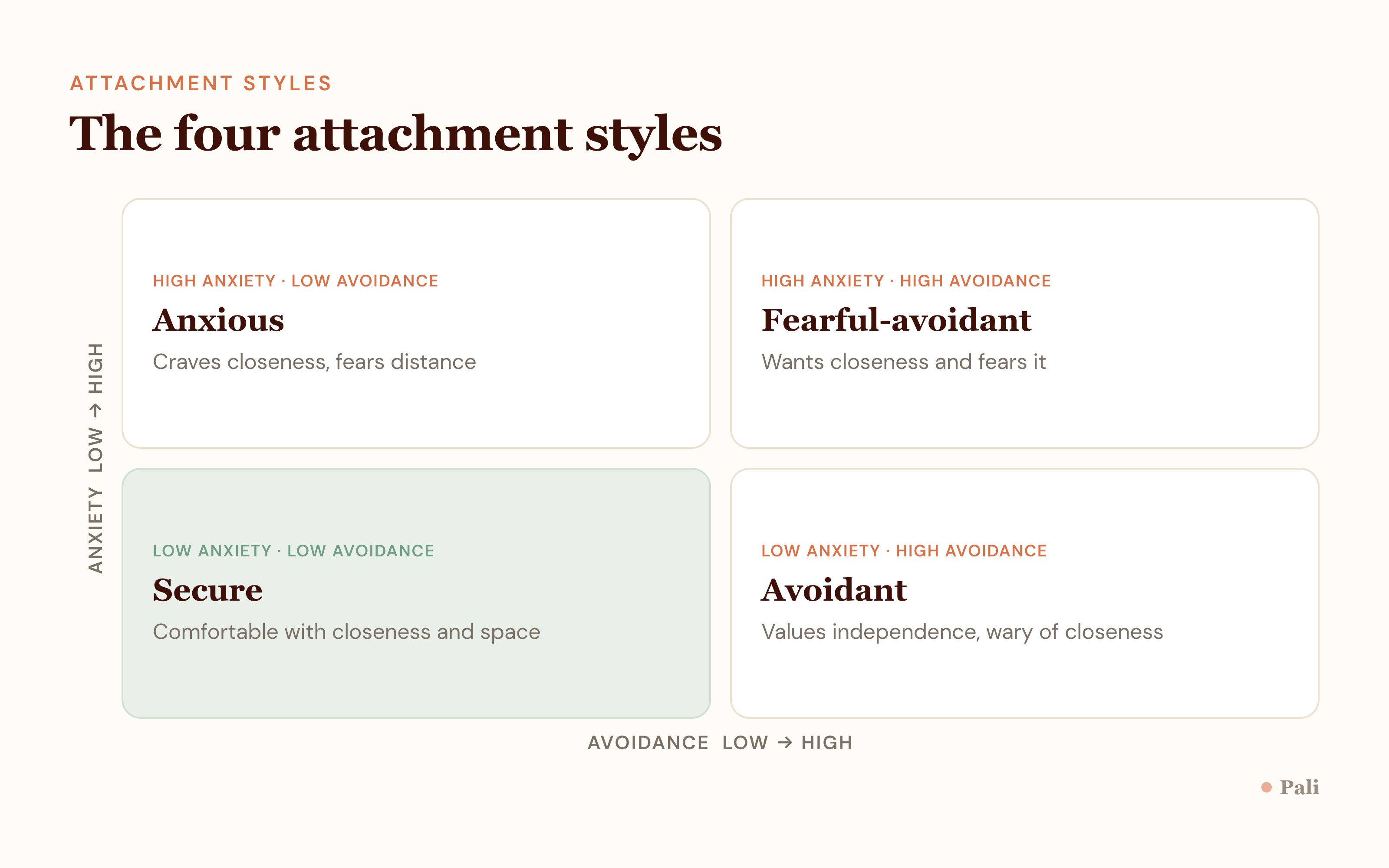
| Style | Core experience | In relationships | Under stress |
|---|---|---|---|
| Secure | Comfortable with closeness and with space | Trusts, repairs after conflict, asks directly | Reaches out, stays regulated |
| Anxious | Fears distance and abandonment | Seeks reassurance, reads into small signals | Protests, pursues, overthinks |
| Avoidant | Values independence, wary of dependence | Keeps some distance, self-reliant | Withdraws, shuts down, needs space |
| Fearful-avoidant | Wants closeness and fears it at the same time | Hot and cold, push and pull | Swings between pursuing and withdrawing |
Reading these, you might see yourself clearly in one, or you might see pieces of two. Both are common. Many people lean one way in calm moments and another way when they feel threatened.
What causes your attachment style?
Attachment patterns are shaped early, mostly by how consistently your needs were met by the people who cared for you. When closeness felt reliable and safe, secure patterns tend to form. When it felt unpredictable, distant, or frightening, the nervous system adapts by becoming either more vigilant about connection or more self-reliant.
This is worth saying plainly: an insecure attachment style is not a character flaw, and it is not your fault. It was a sensible adaptation to the relationships you had. The useful question is not why am I like this, but rather, does this pattern still serve me now.
How common is each attachment style?
Attachment is not rare or unusual. It describes everyone.
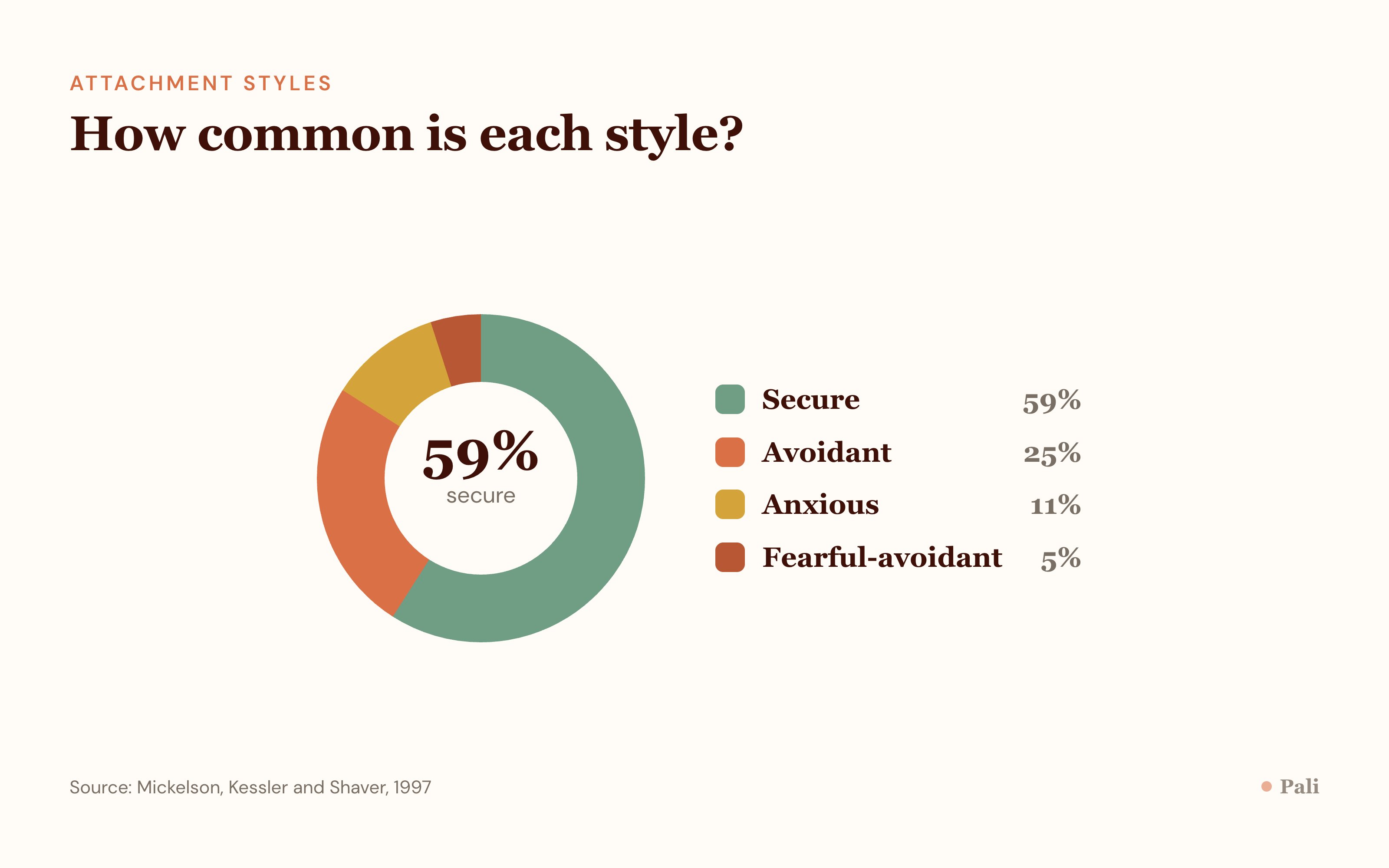
The classic research by Hazan and Shaver in 1987 found roughly 60 percent of adults are secure, with about 20 percent anxious and 20 percent avoidant. A larger nationally representative study by Mickelson, Kessler and Shaver in 1997 found a similar pattern, with around 59 percent secure, 25 percent avoidant, and 11 percent anxious, and the remainder fearful-avoidant.
In other words, if you are working with an insecure pattern, you are in the company of roughly four in ten people. You are not an outlier, and you are not broken.
How does attachment show up in dating and relationships?
Attachment is quietest when things are going well and loudest the moment they feel uncertain. A delayed text, a quiet partner, a vague plan, these are the situations where your style takes the wheel.
Anxious patterns tend to read uncertainty as a threat, which can look like checking, seeking reassurance, or struggling to settle until contact is restored. Avoidant patterns tend to read closeness as a demand, which can look like needing space, going quiet, or feeling crowded. Fearful-avoidant patterns often feel both pulls at once, wanting to move closer and to pull back in the same conversation.
When two styles meet, the pattern matters more than either person alone. The anxious-avoidant pairing is the most well known, where one person pursues connection and the other protects their space, and each move makes the other more extreme. If you recognise that loop, it is the cycle that is the problem, not the two people in it.
Can you change your attachment style?
Yes. Attachment styles can change, and the shift toward security has a name in the research: earned security. People develop it through corrective experiences, including stable relationships, reflection, and the slow practice of staying present with closeness instead of bracing against it.
Change here is rarely a single breakthrough. It is small and repeated. It looks like noticing the pattern a little earlier each time, and choosing a slightly different response. Over many small moments, the nervous system gathers new evidence that closeness can be safe.
How to start moving toward secure attachment
You do not need to overhaul yourself. A few honest, repeatable steps tend to do more than any dramatic effort.
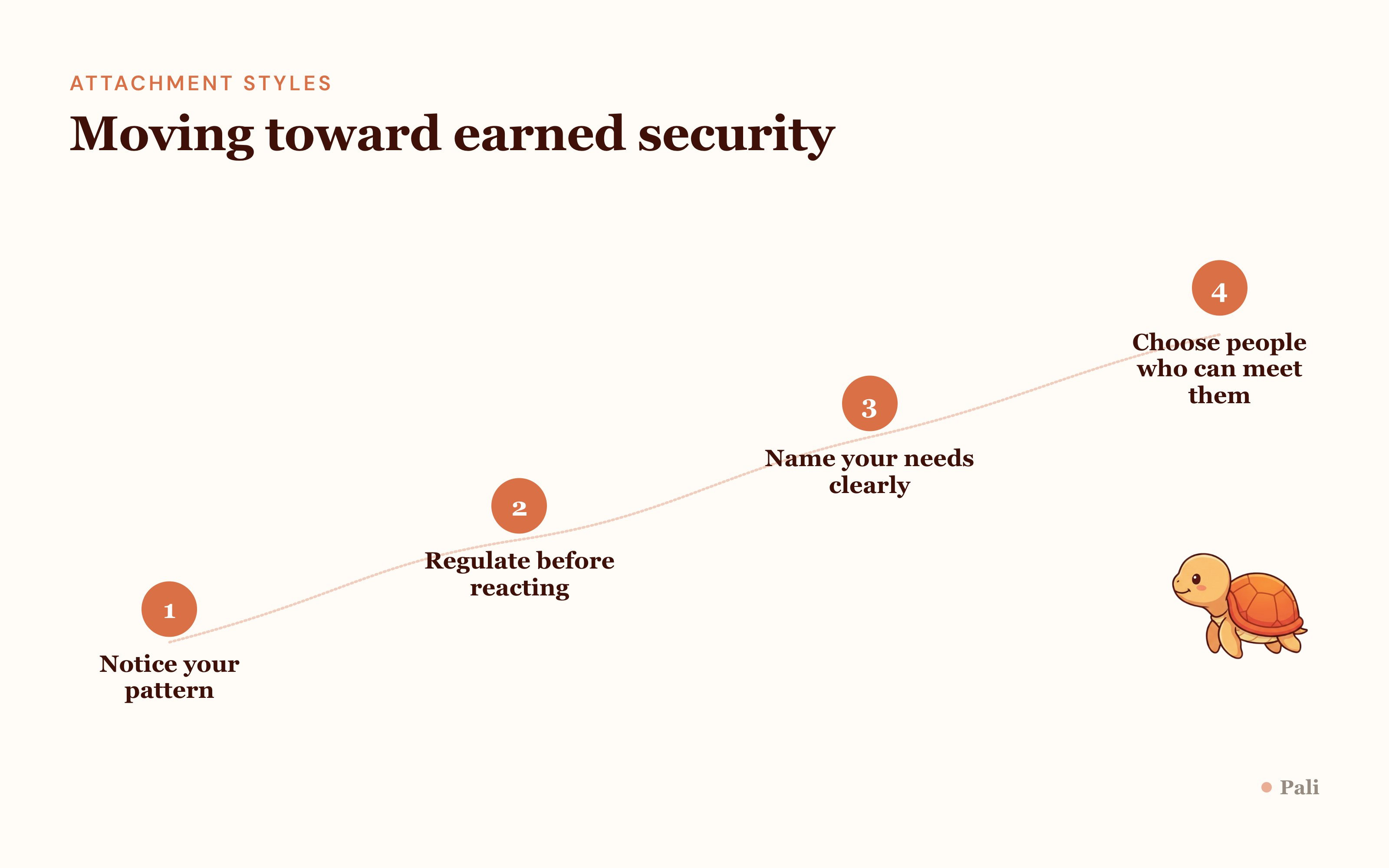
- Name your pattern without judging it. Notice what tends to happen for you when a relationship feels uncertain.
- Find the feeling under the reaction. Beneath the urge to chase or to withdraw, there is usually fear, loneliness, or a need for reassurance. Name that instead.
- Slow the moment down. Most attachment reactions are fast. A pause, a breath, a short walk, anything that buys time, changes what you do next.
- Make one direct, low-stakes request. Secure connection is built by asking clearly for small things, rather than hinting or going silent.
- Repair when you miss. Everyone reacts from their old pattern sometimes. Circling back and naming it is itself a secure move.
If you would like structure around this, Pali’s course Your Attachment Style walks through your specific pattern step by step, and Earned Security focuses on the slow work of building a more secure base. You can explore both inside the app.
Frequently asked questions
What is the rarest attachment style? Fearful-avoidant, also called disorganized, is the least common of the four. It combines a strong desire for closeness with a strong fear of it.
Can you have more than one attachment style? Many people lean one way most of the time and shift toward another under stress, or behave differently with different partners. Patterns are tendencies, not fixed categories.
Is anxious attachment a mental health condition? No. Attachment styles are normal patterns of relating, not diagnoses. They can affect wellbeing, but having an insecure style is not in itself a disorder.
How long does it take to change your attachment style? There is no fixed timeline. Earned security develops gradually through repeated experiences of safe connection, so it is measured in months and years of small shifts rather than days.
Where to go next
If you want to understand your own pattern in more depth, start with the piece that fits you: anxious attachment, avoidant attachment, fearful-avoidant attachment, or how to become securely attached.
Pali is a psychology backed companion that helps you understand your patterns and practice new ones, with structured courses, journaling, and gentle AI support. You can start a free 7-day trial and begin with the attachment work that fits where you are.
Related reading
- What Is Your Attachment Style?
- Why You Keep Attracting the Wrong Partners
- Signs You Are Emotionally Unavailable
- How to Build Emotional Intelligence in Relationships
Pali is designed for self-improvement and educational support. It is not therapy and is not a substitute for professional mental health care. If you are in crisis or thinking about harming yourself, please contact your local emergency services or a crisis line in your country.