
Best Apps for Getting Over a Breakup (2026)
Short answer: pick a breakup app by the stage you are in, not by the longest feature list.
- First weeks, when you mainly need to stop texting your ex: a no-contact tracker like Let it Go (free core features).
- Want to make sense of what happened and rebuild over a few months: a structured, course-based app. Pali (7-day free trial) is built around this, and so is Mend’s heartbreak program.
- Can’t sleep and the anxiety is loud: Headspace or Calm are good additions, though they are not breakup apps.
Below is how the main options compare, what each is actually good at, and how to choose. We make Pali, so we have tried to be specific about where other apps are the better fit.
Breakup apps compared (2026)
| App | Best for | Main tools | Price model |
|---|---|---|---|
| Pali | Structured recovery from the first week to rebuilding | Breakup courses (stabilise, process, rebuild), AI coach, journaling | 7-day free trial, then from 7.99 euro a month |
| Let it Go | Holding no contact | No-contact streak, trigger log, journal, affirmations, community | Free, optional paid coaching |
| Mend | Audio-led heartbreak program | Lessons, journaling, days-since-contact tracking | Paid program |
| Break-Up Boss | A quick morale boost | Pep talks, a “fake text” feature, SOS quotes | One-time purchase (not updated since 2017) |
| Headspace, Calm | Sleep and anxiety | Meditations, sleep stories | Subscription after a free trial |
Prices and features change. Check the current details in your app store before you subscribe. Several unrelated apps now also use the name “Mend”, so check the developer before you download.
What should a breakup recovery app actually do?
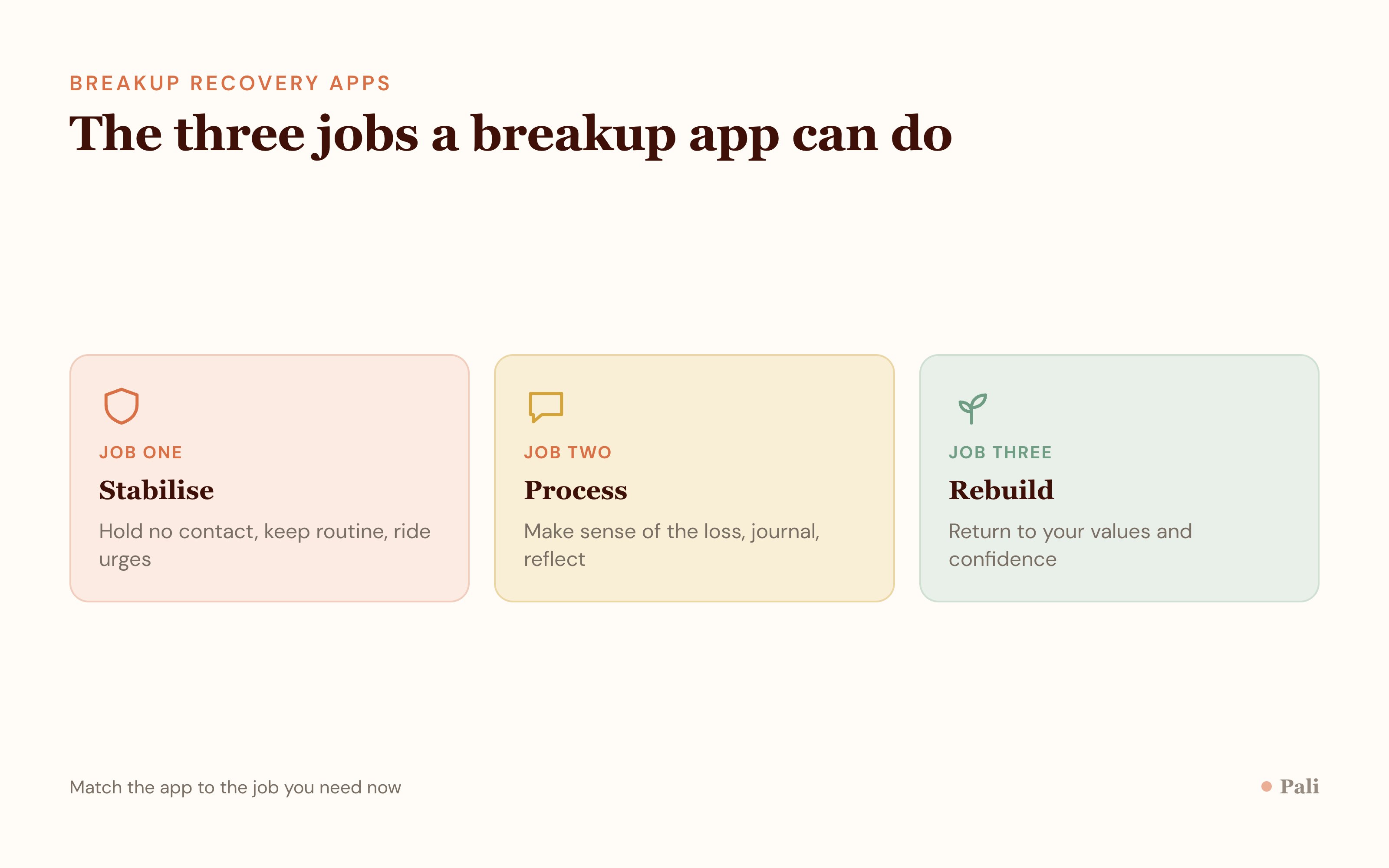
A good breakup app does a few specific jobs rather than promising to make the pain disappear:
- Help you ride the urge to contact your ex without acting on it.
- Give your thoughts somewhere to go so they stop circling at 2am.
- Turn your attention back to your own life once the first wave has passed.
Research on recovery is reassuring. In a 2007 study published in the Journal of Positive Psychology, most participants reported feeling meaningfully better, and even reported personal growth, around eleven weeks after a breakup. An app should support that natural recovery, not rush it.
The apps in more detail
Pali: structured recovery with an AI coach
Pali is an individual-first relationship coach built on CBT, ACT and attachment theory. For breakups, it starts with a stabilising course (Reset & Stabilise) and only later moves into processing the loss and rebuilding (Rebuild & Grow). Lessons take a few minutes and follow the same rhythm: learn one idea, reflect on your own situation, try a small experiment, then debrief. An AI coach and a journal sit alongside the courses for the moments in between.
- Good fit if: you want one app that follows you from week one to feeling like yourself again, and you like structure.
- Less good if: you only want a no-contact counter, or you want a free app with no subscription.
- Price: 7-day free trial, then Premium at 7.99 euro a month or Unlimited at 12.99 euro a month, with cheaper annual plans.
Let it Go: the no-contact specialist
Let it Go is built around the no contact rule: a streak counter, a trigger log, a breakup journal, daily affirmations and a support community. The core app is free, with optional paid coaching.
- Good fit if: your biggest struggle right now is not reaching out.
- Less good if: you want guided lessons on why the relationship went the way it did.
Mend: an audio-led heartbreak program
Mend offers a heartbreak program with lessons, journaling and a tracker for the days since you last contacted your ex. It suits people who like listening more than reading.
- Good fit if: you want a guided, course-style program in audio.
- Less good if: you want AI conversation or tools that also cover dating again later.
Break-Up Boss: a pep talk in your pocket
Created by author Zoë Foster Blake, Break-Up Boss gives short, funny pep talks, a “fake text” feature to vent without sending anything, and SOS quotes. It is a one-time purchase, but it has not been updated since 2017.
- Good fit if: you want a quick morale boost and a laugh.
- Less good if: you want depth or anything that changes over time.
Headspace and Calm: for sleep and anxiety
Neither is a breakup app, but heartbreak wrecks sleep and spikes anxiety, and these two are very good at both. Headspace has courses on difficult emotions; Calm is strongest for sleep.
- Good fit if: sleep and racing thoughts are the main problem.
- Less good if: you want help understanding the relationship or your patterns.
How do these apps map to breakup recovery?
Recovery tends to move through three phases. Trying to “process everything” in week one usually backfires, which is why the right tool changes as you do.
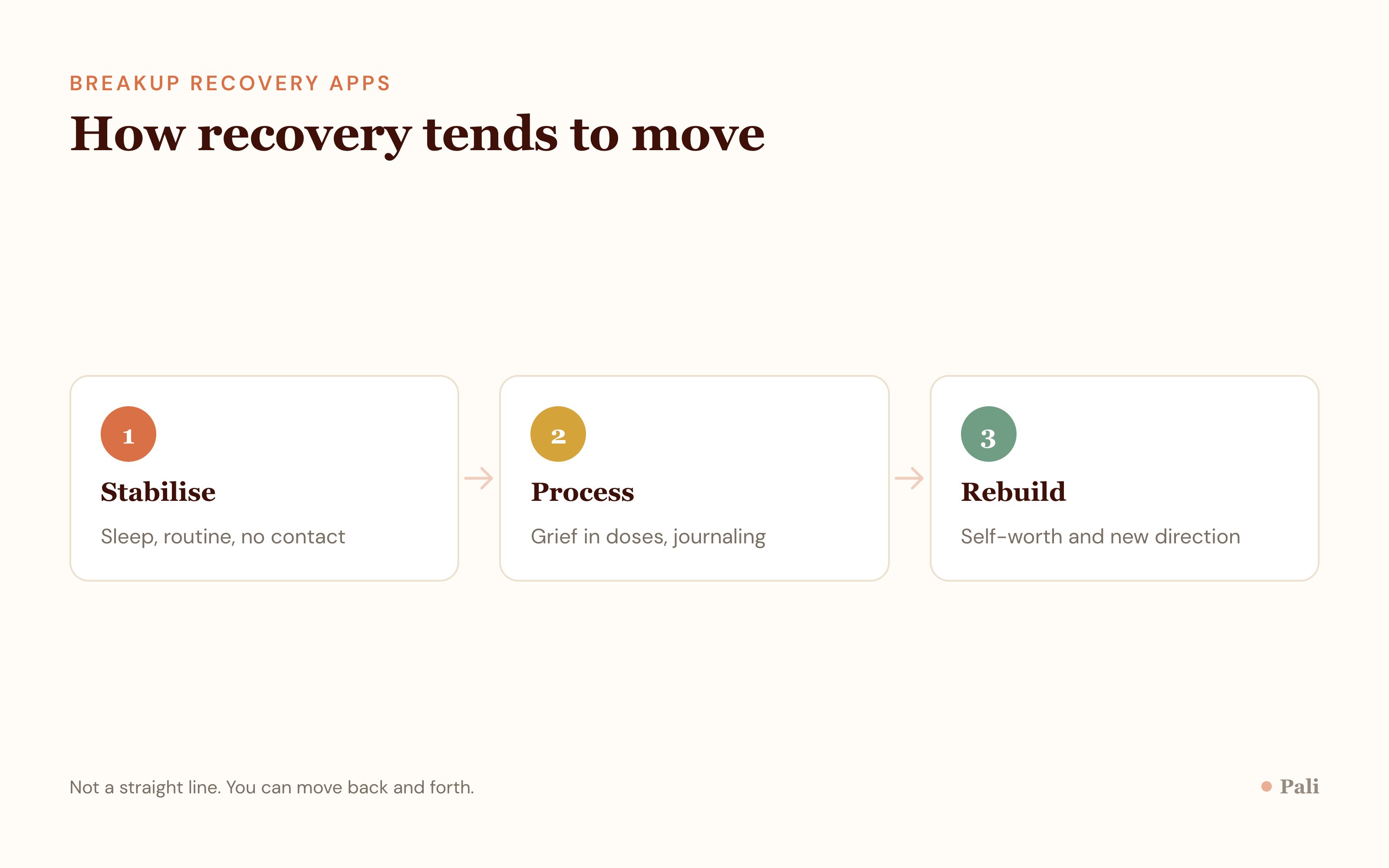
- Stabilise (roughly the first two weeks). Sleep, routine and not reaching out. No-contact trackers and grounding tools shine here.
- Process (weeks two to eight). Making sense of the relationship and the loss. Journaling and guided reflection help, and this is when missing your ex tends to spike.
- Rebuild (from about week six). Returning to your own values and confidence, including rebuilding self-worth after a breakup.
The phases overlap and there is no deadline. If you would rather not switch apps between phases, choose one built for all three.
How to choose in two questions
- What is the hardest part this week? If it is not texting them, start with a no-contact tracker. If it is the thinking, the “why”, or feeling lost, start with a structured course app.
- Do you want to be guided or to guide yourself? Guided people do better with daily lessons and a coach. Self-guided people often prefer a journal and a streak.
Many people combine two: a no-contact tracker for the urges and a course-based app for the deeper work.
Is an app enough, or do I need more support?
An app is a strong companion for everyday recovery, but it is not a substitute for professional care. If you are dealing with thoughts of self-harm, abuse, or distress that does not ease, reach out to a doctor or a local crisis line. If you are weighing structured support more broadly, our guide to relationship coaching versus therapy explains where each one fits. The whole arc of recovery is covered in our pillar on how to get over a breakup.
Frequently asked questions
What is the best free app to get over a breakup?
Let it Go is the strongest free option. Its core features, a no-contact streak, trigger log, journal and community, cost nothing. Most course-based apps, including Pali, run on a free trial and then a subscription.
Do breakup apps actually work?
They help most by supporting habits that aid recovery: not contacting your ex, journaling, and keeping a routine. Research suggests most people feel noticeably better within about three months, and the right app can make that stretch steadier.
Which app is best for the no contact rule?
A dedicated no-contact tracker such as Let it Go is built for exactly this, with streak counters and trigger logs. Pali supports no contact as part of a wider recovery plan rather than as a standalone counter.
How much do breakup apps cost?
From free (Let it Go’s core app) to a one-time purchase (Break-Up Boss) to monthly subscriptions. Pali offers a 7-day free trial, then Premium at 7.99 euro a month or Unlimited at 12.99 euro a month, with discounted annual plans.
Is there an AI app for getting over a breakup?
Yes. Pali pairs breakup courses with an AI coach you can talk to when the feelings hit, and it points you to crisis resources if a conversation turns unsafe. It is a coach, not a therapist.
Pali is designed for self-improvement and educational support. It is not therapy and is not a substitute for professional mental health care.