
Anxious Attachment: Signs and How to Heal
Anxious attachment is a pattern where closeness feels safe but uncertainty feels threatening, so your mind works hard to keep a partner near and to read every sign of their mood. It is not a flaw or a diagnosis. It is a learned survival strategy from earlier relationships, and because it is learned, it can be gently rewired toward security.
If you tend to overthink texts, fear abandonment, or feel calm only when a partner is clearly reassuring, this is for you.
What are the signs of anxious attachment?
Anxious attachment shows up as a familiar cluster of feelings and behaviours. You might recognise several of these:
- A strong fear of being left, even when nothing is obviously wrong.
- Needing frequent reassurance that you are loved and that things are okay.
- Reading deeply into tone, delays, and small changes in a partner’s behaviour.
- Feeling preoccupied with the relationship, sometimes at the cost of your own focus.
- Protest behaviours when you feel distant, such as testing, withdrawing to be chased, or repeated messaging.
- Quick relief when contact is restored, followed by the cycle starting again.
This pattern is common. In the original adult attachment research by Cindy Hazan and Phillip Shaver in 1987, about 20 percent of adults described themselves in anxious terms, with roughly 60 percent secure and 20 percent avoidant. You are far from alone, and the style is workable.
Why does anxious attachment feel so intense?
The intensity makes sense once you see the loop. Attachment researcher John Bowlby described how humans seek a “secure base,” a person whose presence calms our nervous system. When that base feels uncertain, the anxious system sounds an alarm and pushes you to restore closeness fast. The relief you feel when a partner responds is real, but it also teaches your brain that the alarm worked, so the loop repeats.
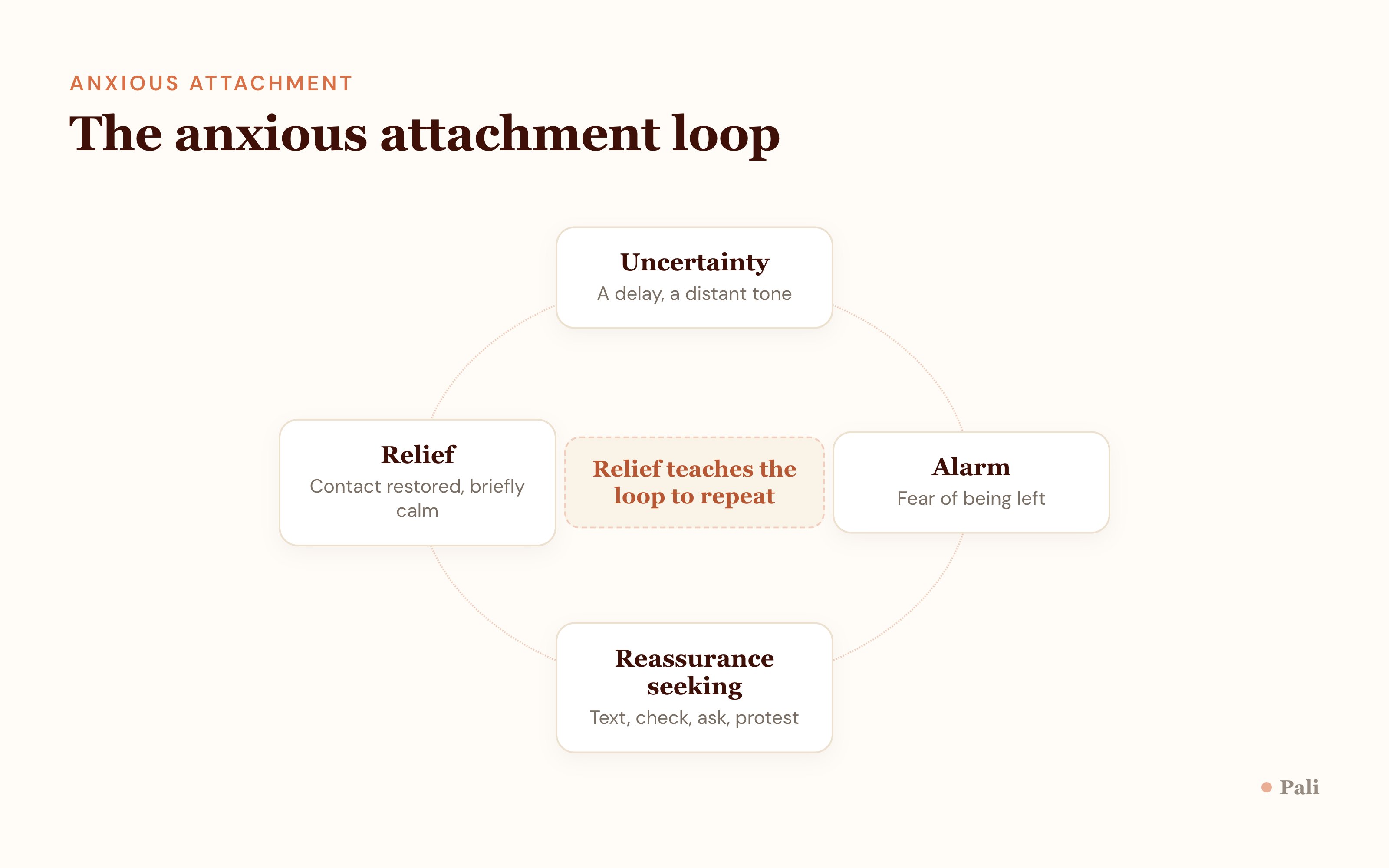
Understanding this is the first real step. The goal is not to stop caring, it is to widen the gap between the alarm and your response so you get to choose what happens next. If this loop feels familiar across several relationships, you may also recognise the pattern in why you keep attracting the wrong partners.
How do you heal anxious attachment?
You move toward what is often called earned security: a felt sense of safety you build through practice rather than inherit. It happens in small, repeatable shifts, not one big change.
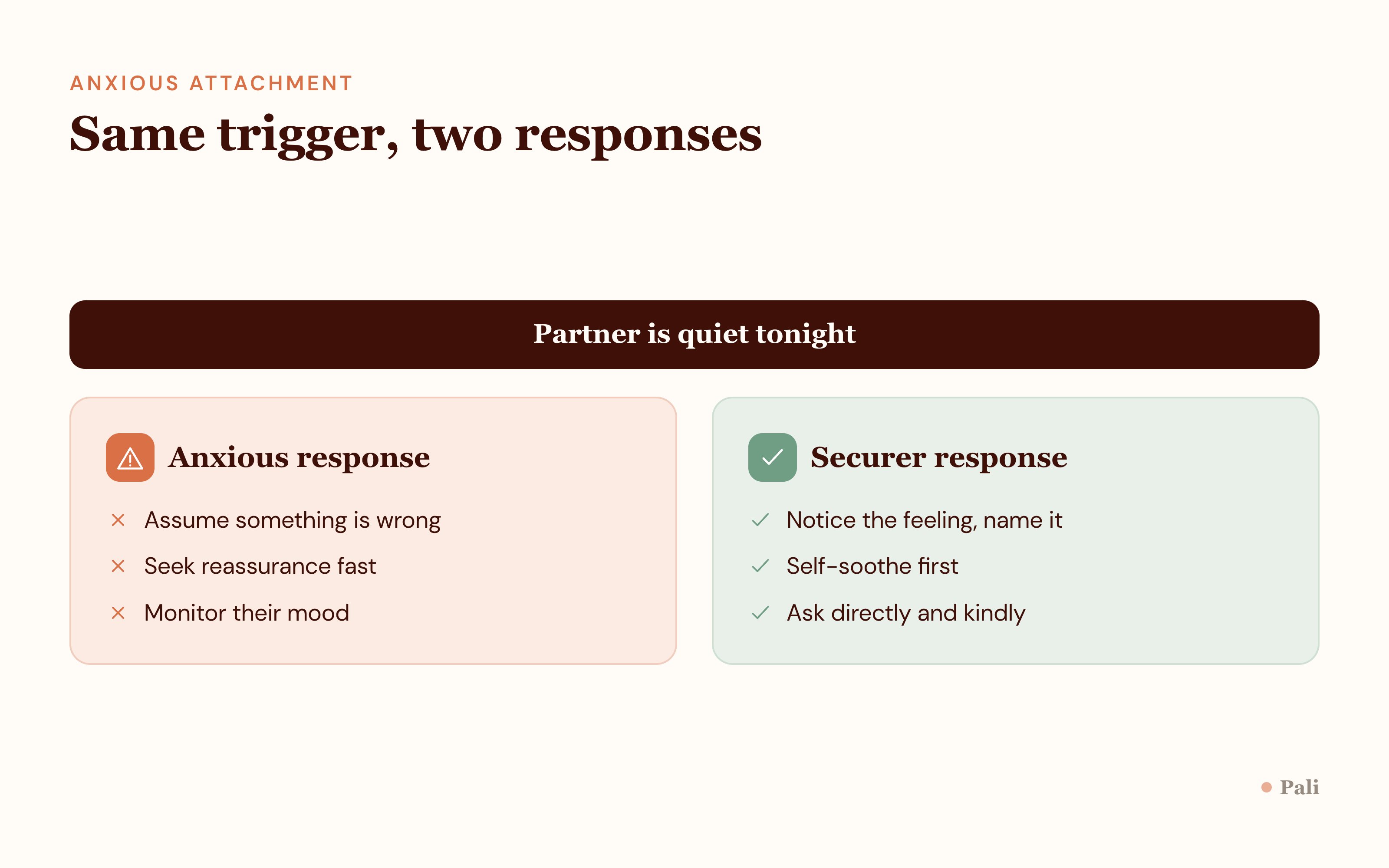
- Name the feeling before you act. When the alarm fires, label it (“I am feeling abandonment fear”) to create a pause. This single step interrupts the automatic loop.
- Soothe your own nervous system first. A few slow breaths, a walk, or grounding before you send the text. Self-regulation lowers the urgency.
- Ask for reassurance directly and kindly. Clear requests (“a quick text when you land would help me”) work better than tests or hints.
- Build a life outside the relationship. Friendships, routines, and meaning give your nervous system more than one secure base.
- Notice the relief loop. When contact calms you, acknowledge it without treating it as proof the alarm was right.
In Pali, the Earned Security course turns these into short daily reflections and real-life experiments, so the new pattern has a chance to stick. You can also explore where you sit overall with our guide to what your attachment style is, see the contrasting pattern in avoidant attachment, or start from the top with the complete guide to attachment styles.
Frequently asked questions
Can anxious attachment be cured? It is not an illness to cure, it is a pattern to soften. With consistent practice, many people move toward earned security and feel noticeably calmer in relationships, though the old pattern can still flicker under stress.
What causes anxious attachment? It usually develops when early caregiving felt inconsistent, sometimes warm and sometimes unavailable, so closeness became something to monitor. Later relationships can reinforce or ease it.
Is anxious attachment the same as anxiety? No. Anxious attachment is a relationship specific pattern. It can overlap with general anxiety, but they are different and one does not require the other.
How long does it take to feel more secure? There is no fixed timeline, but small shifts can show up within weeks of consistent practice. Deeper change tends to build over months as new experiences accumulate.
Pali is designed for self-improvement and educational support. It is not therapy and is not a substitute for professional mental health care.