
How to Stop Ruminating About an Ex
To stop ruminating about an ex, you interrupt the loop rather than try to think your way out of it. Rumination feels like problem solving, but it is really the same painful thoughts circling without resolution. The way out is to notice the spiral early, gently redirect your attention, and give your mind something concrete to do instead.
Why can’t I stop thinking about my ex?
Rumination is your mind trying to resolve something it cannot. After a breakup there are open questions with no clean answers, why it ended, what you could have done, whether they think about you. Your brain treats these like puzzles and keeps returning to them, hoping that one more replay will finally make it make sense.
It almost never does. Researchers who study rumination, including the psychologist Susan Nolen-Hoeksema, have described how this repetitive focus tends to deepen low mood rather than relieve it. The thinking feels productive, but it mostly keeps the wound open.
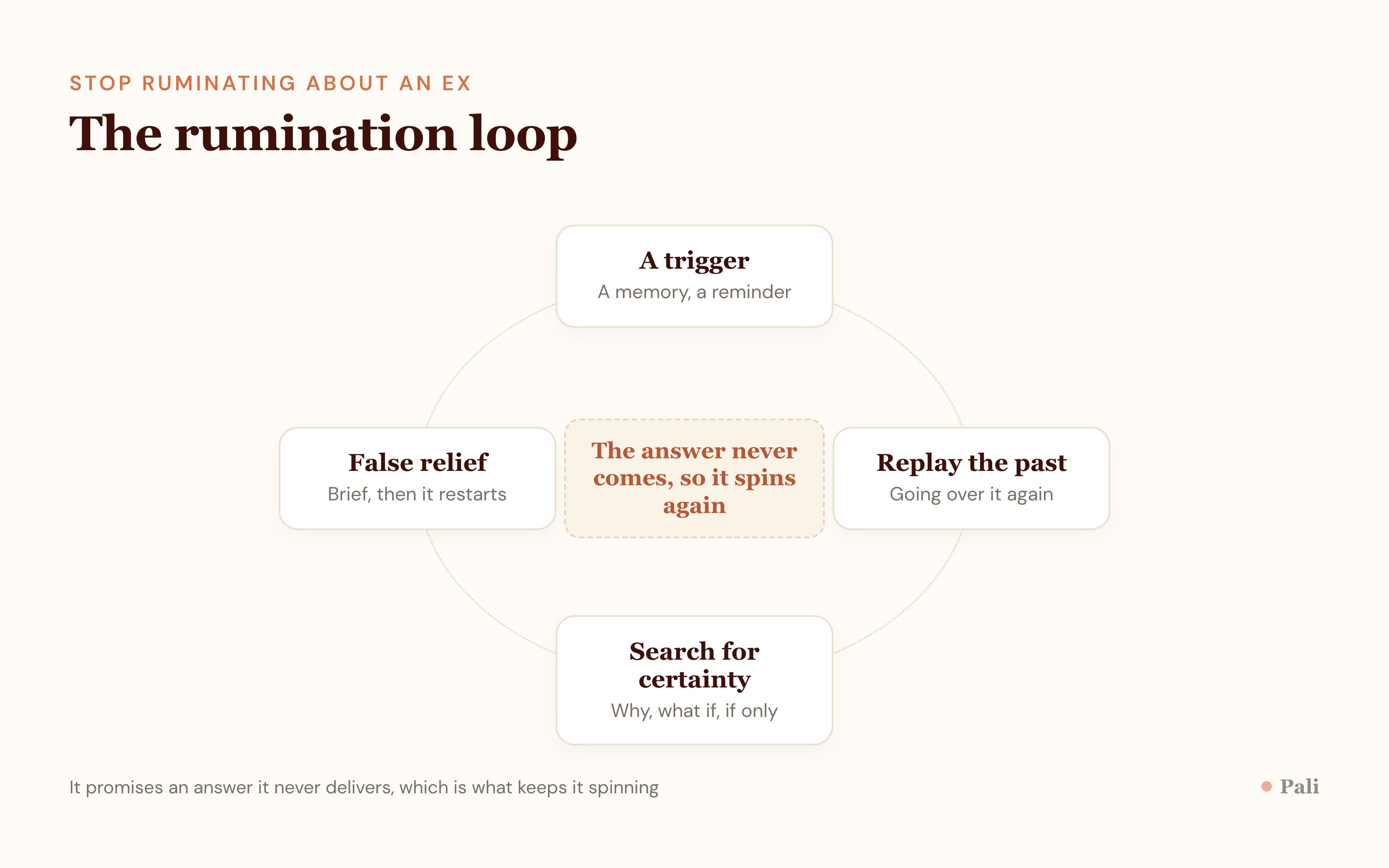
This is closely related to the craving loop behind why you keep reaching out or checking their profile, which is why the no contact rule and reduced contact help here too.
How do you interrupt the spiral?
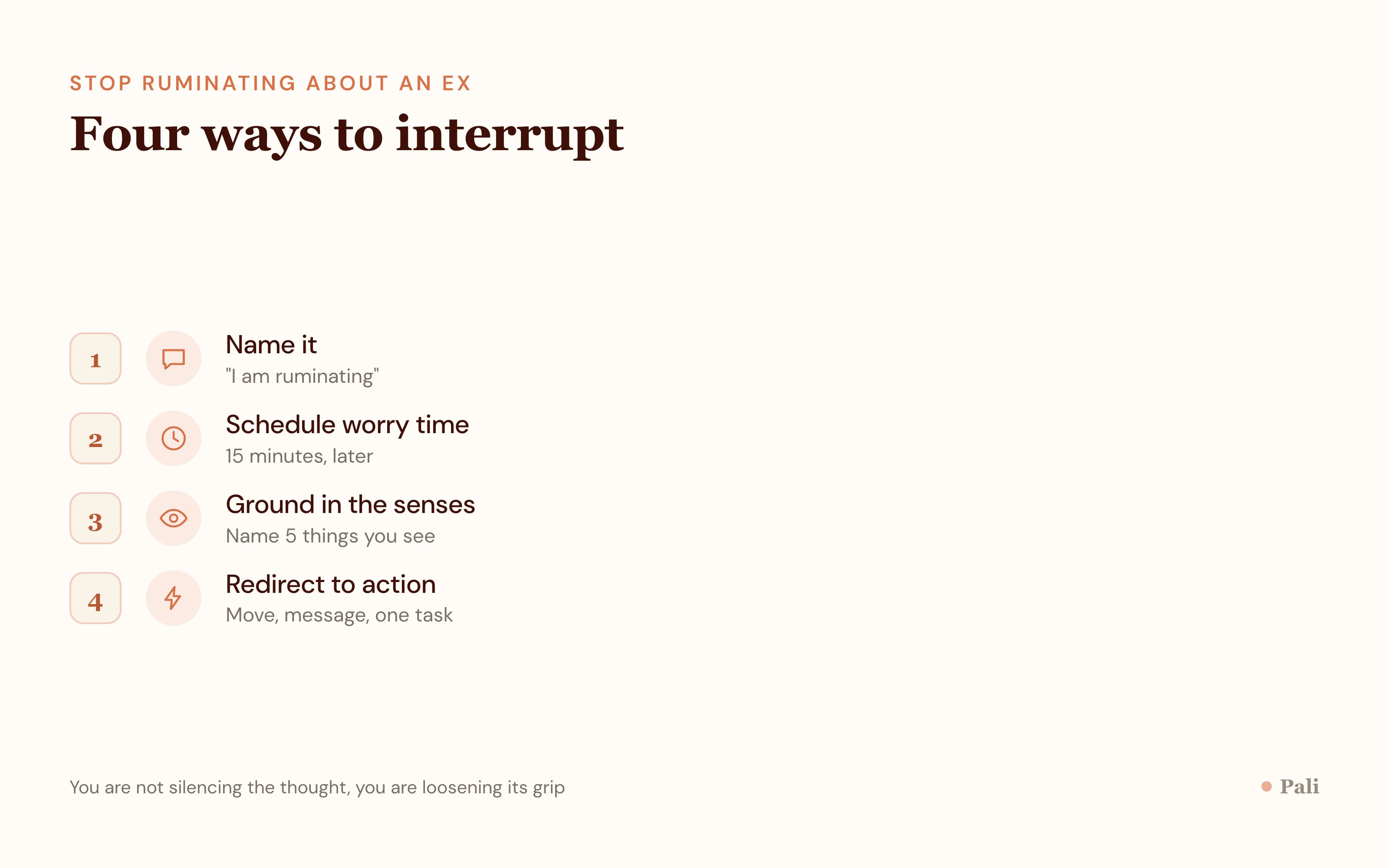
You cannot force a thought to leave, but you can change what you do with your attention. A few techniques that help:
- Name it. Saying “I am ruminating” to yourself creates a small gap between you and the thought.
- Schedule worry time. Give the thoughts a set fifteen minutes later in the day instead of all day. Often they lose urgency by then.
- Ground in the present. Use your senses, name five things you can see, to pull your mind out of the past.
- Redirect to action. Move your body, message a friend, do one small task. Action competes with rumination for the same mental space.
- Externalise it. Write the thought down. On paper it often looks smaller and more finite than it felt in your head.
Is rumination the same as missing someone?
Not quite, and the difference matters. Missing someone is an emotion that rises and falls. Rumination is a thinking pattern that loops. You can miss an ex without ruminating, and you can ruminate even about a relationship you are glad to be out of.
If what you mostly feel is the ache of absence, how to stop missing your ex speaks to that more directly. If the issue is a mind that will not stop circling in general, the skills in how to stop overthinking everything transfer well.
When does rumination need more support?
Some looping is a normal part of grief and tends to ease as you heal, which our guide to how to get over a breakup covers. If the thoughts become constant, stop you functioning, or come with hopelessness that does not lift, that is a sign to reach out to a doctor or mental health professional. There is no shame in needing more than self-help, and asking for support is a strong move, not a weak one.
For the everyday spiral, Pali can help you catch it earlier and redirect, gently and on your own terms.
Frequently asked questions
Why do I keep replaying the relationship in my head? Your mind is trying to resolve unanswered questions. Because there is no clean answer, it loops. Recognising this as rumination, not problem solving, is the first step out.
Does rumination mean I still love my ex? Not necessarily. Rumination is a thinking habit, not proof of love. You can ruminate about a relationship you are relieved to have left.
How is overthinking different from grieving? Grief is an emotion that moves in waves and gradually softens. Rumination is a repetitive thought pattern that tends to keep distress stuck rather than process it.
What is the fastest way to stop ruminating in the moment? Interrupt your attention with your body or senses. Stand up, move, or name five things you can see. Action competes directly with the loop.
Pali is designed for self-improvement and educational support. It is not therapy and is not a substitute for professional mental health care.