
How to Get Over a Breakup: A Psychology Guide
Getting over a breakup happens in two broad phases: first you stabilise, then you rebuild. Early on, the goal is not to feel fine, it is to get steady, protect your routines, and reduce contact with the reminders that keep the wound open. Later, as the intensity settles, the work shifts toward making sense of what happened and rebuilding your sense of self. There is no fixed timeline, and grief that comes in waves is normal, not a sign you are doing it wrong.
If you are reading this in the rawest part, the part where it is hard to eat or sleep or think about anything else, you are not overreacting. A breakup is a real loss, and your mind and body are responding to it as one.
Why do breakups hurt so much?
Breakups hurt because they are a genuine loss on several layers at once. You lose a person, a daily routine, a shared future you had pictured, and often a part of how you understood yourself. The brain treats the loss of an attachment figure as a threat, which is why the early days can feel less like sadness and more like withdrawal, with cravings, restlessness, and difficulty focusing.

This is also why willpower alone rarely settles it. You are not weak for struggling to stop thinking about someone. Your nervous system is doing what it was built to do when a close bond is broken.
What are the stages of a breakup?
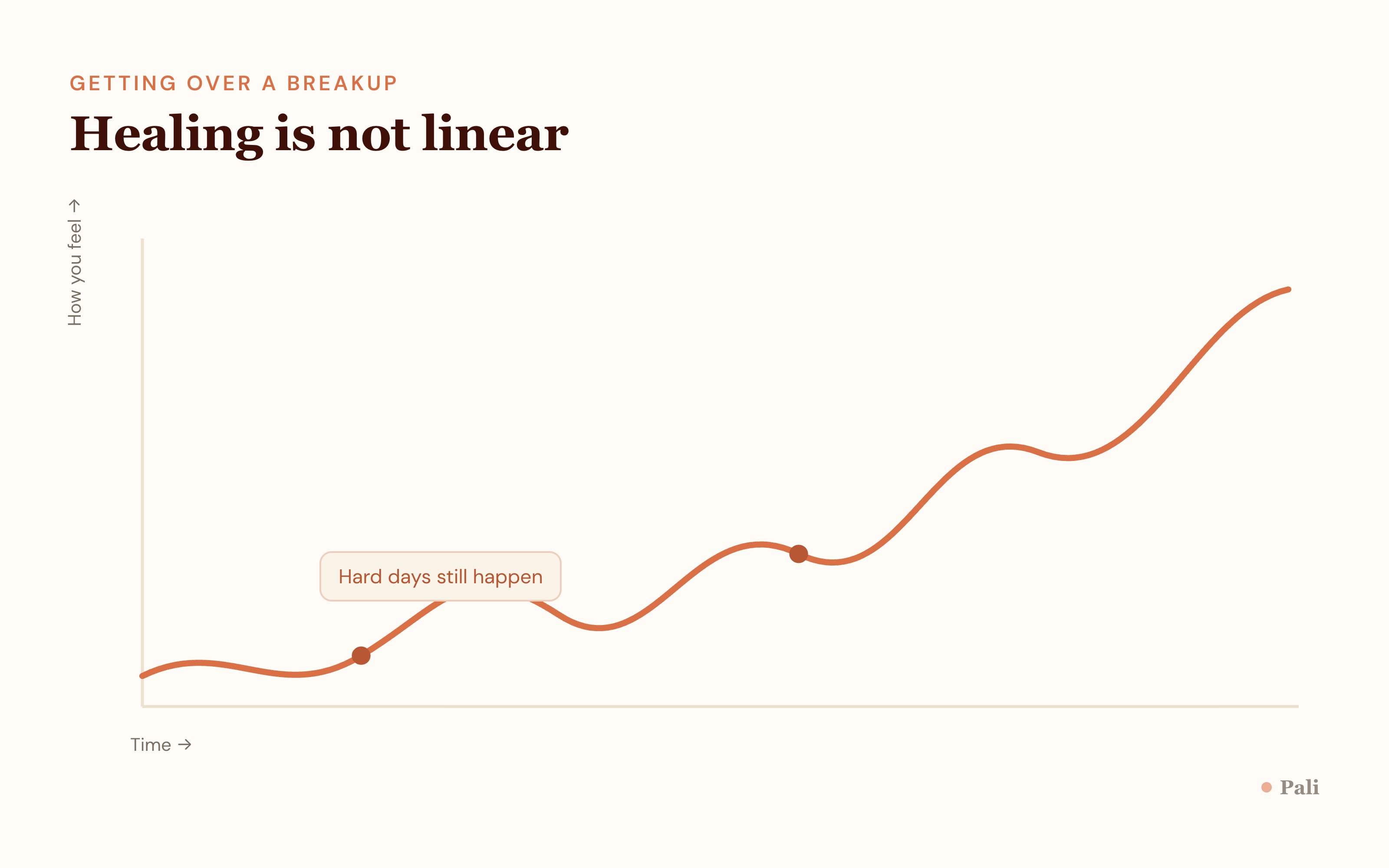
Recovery does not move in a neat line, but most people pass through recognisable phases. Expect to move back and forth between them rather than completing one and never returning.
- Shock and protest. The loss does not feel real yet, and there is often an urge to fix it or reach out.
- Acute grief. The reality lands. This is usually the most painful phase, with strong emotions and rumination.
- Stabilising. The waves come less often and feel less overwhelming. Routines start to return.
- Meaning making. You begin to understand the relationship and your part in it without only blaming yourself or your ex.
- Rebuilding. Energy returns for your own life, interests, and eventually new connection.
You may cycle through several of these in a single week. That is normal.
How long does it take to get over a breakup?
There is no reliable number, and any source that gives you an exact figure is guessing. What research does show, consistently, is that people tend to overestimate how long and how intensely a loss will hurt. This is called the impact bias in affective forecasting research, and in practice it means the future you are dreading is usually more bearable than it feels right now.
What shapes your timeline is less about the calendar and more about what you do: how much you reduce reminders early on, whether you keep your basic routines, and whether you process the loss rather than only distracting from it.
Does the no contact rule work?
For most people, reducing contact early helps, because every text, check of their profile, or update from a mutual friend reopens the wound and resets the nervous system. The point of no contact is not punishment or strategy. It is giving yourself the quiet your mind needs to begin settling.
No contact is not absolute, and it does not suit every situation. If you co-parent, share a home, or work together, full silence is not realistic, and the goal becomes the lowest necessary contact rather than none. The principle is the same either way: protect yourself from the reminders that keep restarting the grief.
What actually helps you heal
A few things tend to help more than the rest. None of them are dramatic.
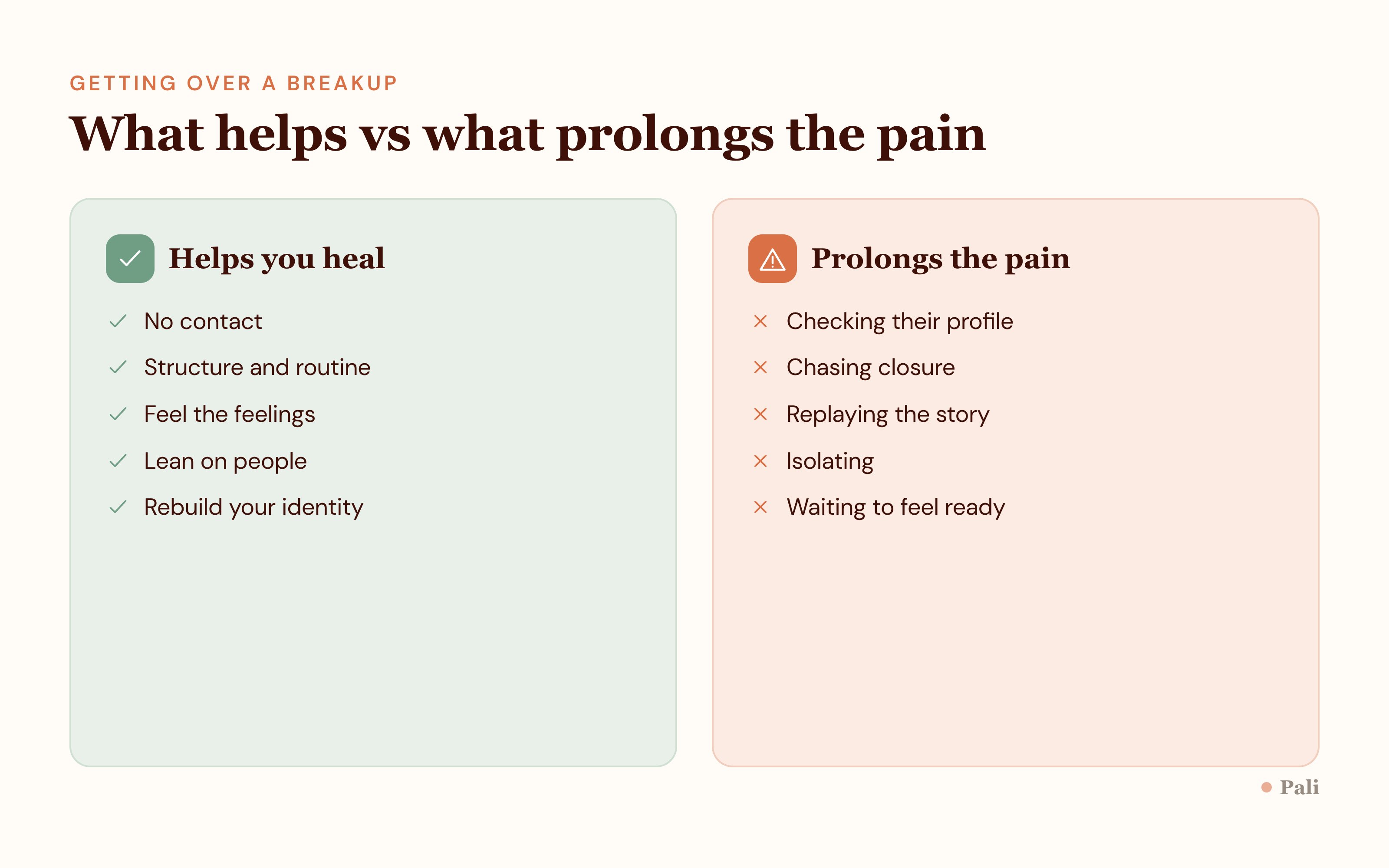
- Protect the basics. Sleep, food, movement, and daylight do more for emotional recovery than they get credit for.
- Reduce the reminders. Mute, unfollow, and put away the objects and photos that pull you back, at least for now.
- Name the feeling under the thought. Rumination is often grief, fear, or longing wearing the disguise of a replayed memory. Naming the feeling settles it faster than arguing with the thought.
- Lean on people, gently. You do not need to perform being fine. A few honest conversations are worth more than many cheerful ones.
- Process, do not only distract. Journaling, reflection, or talking it through helps you metabolise the loss rather than freeze it.
If you want a structured place to do this, Pali’s Reset & Stabilise course is built for the early, acute phase, and Rebuild & Grow focuses on rebuilding confidence and identity once the worst has passed. You can work through them at your own pace.
When a breakup feels like more than grief
Sometimes a breakup sits on top of, or tips into, something heavier than grief. If you are not sleeping for long stretches, cannot function day to day, are using substances to cope, or have any thoughts of harming yourself, please treat that as a signal to reach out to a doctor, a therapist, or a crisis line in your country. You do not have to carry that part alone, and reaching out is a strong move, not a weak one.
Frequently asked questions
Why do I still miss my ex even though the relationship was bad? Missing someone is about the attachment bond and the routine, not a verdict on whether the relationship was good for you. You can know it was right to end and still grieve it.
Is it normal to feel fine and then suddenly fall apart again? Yes. Grief comes in waves, often triggered by a song, a date, or a place. Waves returning is part of healing, not a relapse.
Should I stay friends with my ex? Friendship may be possible later, but staying close immediately usually slows healing because it keeps the bond and the hope active. Many people find space first, then decide.
How do I stop checking their social media? Make it harder than a reflex: mute or unfollow, move the app off your home screen, and replace the check with a small planned action. The urge fades faster when it is not fed.
Where to go next
For the parts that feel most stuck, read on: how to stop missing your ex, the no contact rule explained, how to stop ruminating about an ex, and how to rebuild self-worth after a breakup.
Pali is a psychology backed companion for moving through a breakup at your own pace, with structured courses, guided journaling, and gentle AI support that meets you where you are. You can start a free 7-day trial whenever you feel ready.
Related reading
- The Psychology of Ghosting
- Why You Keep Attracting the Wrong Partners
- What Is Your Attachment Style?
Pali is designed for self-improvement and educational support. It is not therapy and is not a substitute for professional mental health care. If you are in crisis or thinking about harming yourself, please contact your local emergency services or a crisis line in your country right away.