
Why You Fight About the Same Things
If you keep having the same fight, it is usually because the surface topic is not the real one. Recurring arguments tend to sit on top of a deeper, unmet need, so solving the dishes or the schedule never quite settles it. The good news is that this is normal, even in happy relationships, and the loop can be changed once you see what is actually driving it.
Why do we keep having the same argument?
Because most conflict is not meant to be solved. Research by John and Julie Gottman, drawn from decades of studying thousands of couples, found that about 69 percent of relationship conflict is perpetual. These are recurring differences rooted in personality, values, and core needs, not problems with a tidy fix. Only the remaining slice is genuinely solvable.
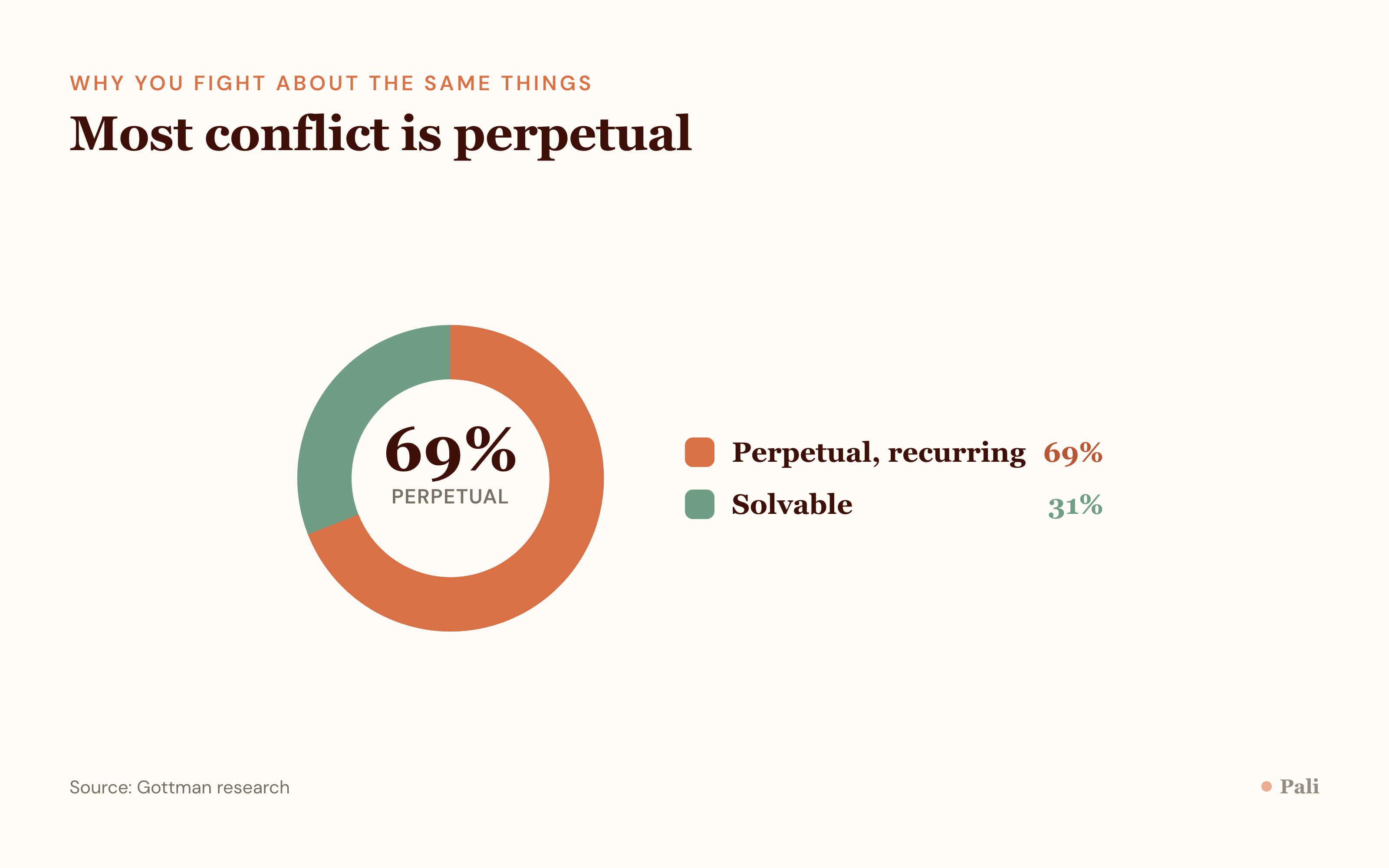
That number is strangely freeing. If most conflict is perpetual, then a recurring argument is not proof that you are incompatible or bad at communicating. It is proof that you are two different people, which you already knew.
What is really underneath the fight?
The topic is the doorway, not the room. A fight about being late might really be about feeling unimportant. A fight about chores might be about feeling unseen. The pattern usually runs like this:
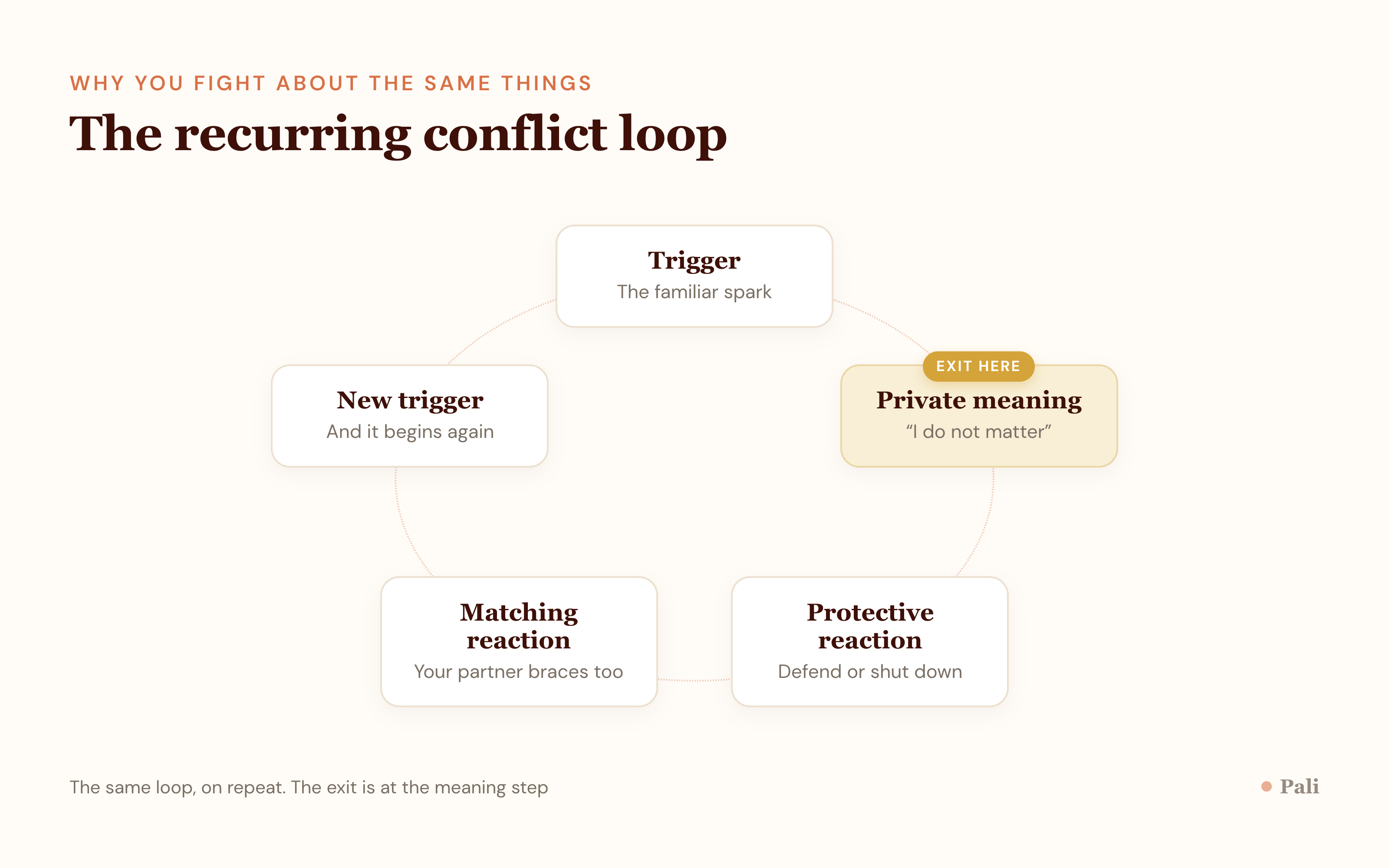
Each partner assigns a private meaning to the trigger, reacts to protect themselves, and that reaction becomes the next person’s trigger. The content changes. The choreography does not. Learning to spot the loop is a core part of healthy communication and of building the emotional intelligence that lets you respond instead of react.
How do you break the cycle?
You do not break it by winning. You break it by changing one move in the loop.
- Name the pattern out loud, together: “we are in the late argument again.” This puts you on the same side of the problem.
- Get curious about the need under the complaint. Ask, “what does this really mean to you?” and listen for the longing, not the logistics.
- Drop the goal of resolution. Aim for understanding. A perpetual problem you can talk about kindly stops being corrosive.
- Repair quickly afterwards. A short, genuine “I am sorry that landed badly” matters more than a perfect argument.
Some recurring fights, especially about money, follow this same pattern with extra heat. If that is your loop, the same approach applies, and you can go deeper in money conflict in relationships.
Frequently asked questions
Is it normal to have the same argument over and over? Yes. Gottman research suggests most relationship conflict is perpetual. The presence of a recurring argument is normal. What matters is whether you can discuss it without contempt.
Does fighting mean we are incompatible? Not by itself. Both happy and unhappy couples have perpetual problems. The difference is in how they handle them, not whether they have them.
How do we stop a fight from escalating? Slow down and take a short break when either of you floods. Twenty minutes of calm before you continue prevents most of the damage.
What if my partner will not talk about the real issue? Lead by example. Share the need under your own complaint without blame, and invite rather than demand. Safety, not pressure, is what opens people up.
Pali is designed for self-improvement and educational support. It is not therapy and is not a substitute for professional mental health care.