
Healthy Communication in Relationships
Healthy communication in a relationship is less about finding the perfect words and more about how two people respond to each other in ordinary moments. It rests on three things: noticing and responding to your partner’s small attempts at connection, staying regulated enough during conflict to repair afterward, and being able to say what you need clearly rather than hinting or withdrawing. Most couples do not have a vocabulary problem. They have a pattern problem.
If conversations in your relationship keep ending in the same place, or the same argument keeps returning in different clothes, that is the thread worth pulling. The argument is usually not about the thing you are arguing about.
What does healthy communication actually look like?
It is quieter than people expect. Healthy communication shows up most in small daily moments, not in big talks. Researcher John Gottman calls these moments bids for connection, the small gestures we make to get a partner’s attention, affection, or support, like sharing a thought or reaching for a hand.
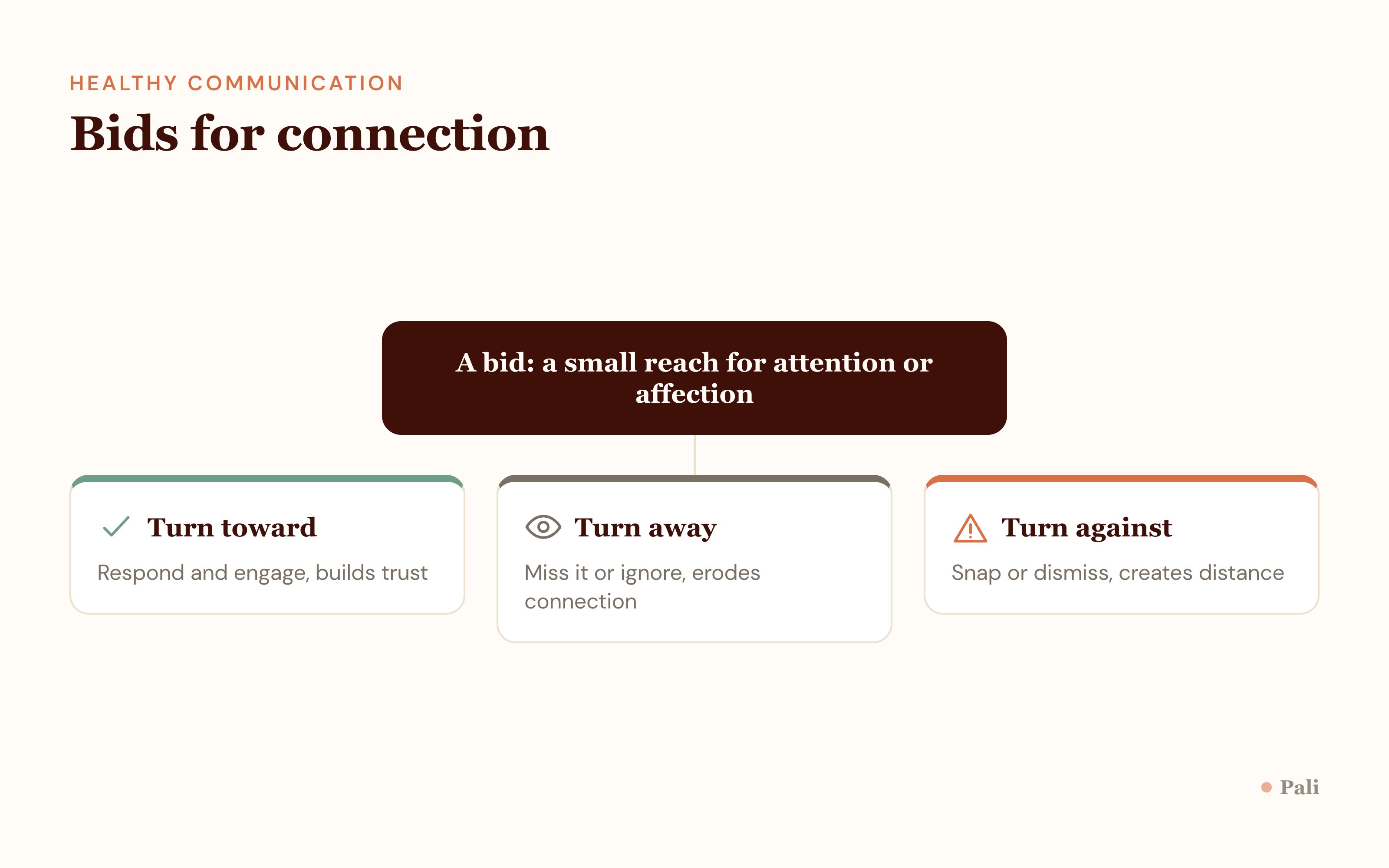
In a study following newlyweds over six years, the Gottman Institute found that couples who stayed together turned toward each other’s bids about 86 percent of the time, while couples who divorced did so only about 33 percent of the time. The difference between the two groups was not how often they fought. It was how often they noticed and responded to each other in the small moments.
That is good news, because small moments are something you can change today.
Why do we keep having the same argument?
Recurring arguments usually run on a cycle. Something happens, each person feels a familiar threat, each protects themselves in a familiar way, and those two reactions feed each other. One partner raises the volume to be heard, the other goes quiet to avoid escalation, and each move makes the other more extreme.
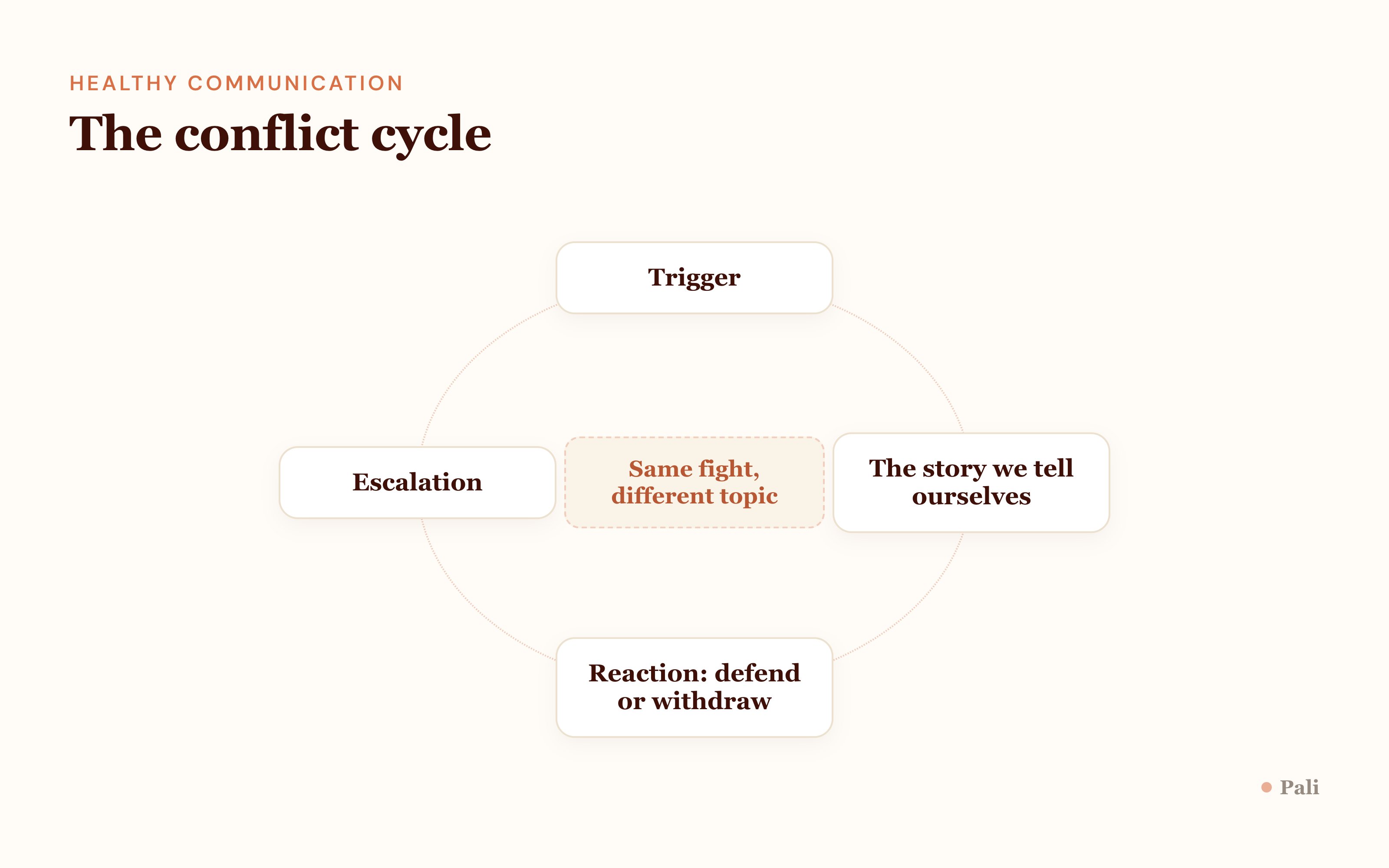
When you are inside this loop, it feels like the content is the problem, the dishes, the money, the plans. Underneath, it is almost always about feeling unseen, unimportant, or unsafe. Naming the cycle together, as a shared pattern rather than one person’s fault, is often the move that loosens it.
What are the patterns that break communication?
Gottman’s research identified four communication habits so corrosive he called them the Four Horsemen. They are worth knowing by name so you can catch them early.
| Pattern | What it sounds like | A gentler alternative |
|---|---|---|
| Criticism | You always, you never, what is wrong with you | Name the specific behaviour and how you feel |
| Contempt | Mockery, eye-rolling, sarcasm, superiority | Build a habit of appreciation and respect |
| Defensiveness | It is not my fault, yes but you | Take responsibility for even a small part |
| Stonewalling | Shutting down, going silent, withdrawing | Name that you are overwhelmed and ask for a short pause |
Of these, contempt is the most damaging. The aim is not to never slip into these, everyone does, but to notice and course correct.
How do you repair after a fight?
Repair is the single most important communication skill, more important than avoiding conflict in the first place. Every couple ruptures. The couples who do well are the ones who come back, name it, and reconnect.
A simple repair has a few parts: acknowledge your part without a but attached, name what you were actually feeling underneath, and make a small move back toward your partner. You do not need to resolve the whole issue to repair the connection. Often reconnecting comes first, and the problem is easier to solve once you are on the same side again.
How do you communicate your needs without a fight?
Many people swing between two unhelpful options: hinting and hoping the other person notices, or staying silent until resentment leaks out sideways. The skill in the middle is direct, low-pressure asking.

- Start with yourself, not them. I have been feeling, rather than you make me feel.
- Name the need plainly. What you want is information, not an accusation.
- Keep the request small and specific. Concrete asks are easier to meet than vague ones.
- Make room for their response. A request invites a conversation, it does not demand a yes.
This is harder than it sounds, especially if your needs were dismissed in the past, because naming them can feel risky. A gentle first step is simply to notice what you needed in a moment, without judging yourself for needing it.
If you want structured practice, Pali’s Conflict to Connection course works on the cycle and repair, Bids for Connection focuses on the small daily moments, and Soft Strength helps with saying what you need. You can work through them solo, even if your partner is not using the app.
Frequently asked questions
What is the most important communication skill in a relationship? Repair. Every couple has ruptures. The couples who last are the ones who reliably come back, take responsibility, and reconnect afterward.
Is conflict in a relationship a bad sign? Not on its own. Conflict is normal and even healthy. What matters is how you fight and whether you repair, not whether you disagree.
How can I communicate better if my partner shuts down? Shutting down, or stonewalling, is often a sign of feeling overwhelmed rather than not caring. Agreeing on a short pause and a time to return to the conversation usually works better than pushing through.
Can I improve communication if I am the only one trying? To a real extent, yes. Changing your own side of a pattern, how you raise issues and how you respond to bids, often shifts the whole dynamic, because the cycle needs both people to keep running.
Where to go next
To go deeper on a specific pattern, read: how to stop a fight from escalating, how to repair after a fight, bids for connection explained, and how to communicate your needs.
Pali is a psychology backed companion that helps you understand the patterns underneath your conversations and practice new ones, with structured courses, journaling, and gentle AI support. You can start a free 7-day trial whenever you are ready.
Related reading
- How to Build Emotional Intelligence in Relationships
- Signs You Are Emotionally Unavailable
- What Is Your Attachment Style?
Pali is designed for self-improvement and educational support. It is not therapy and is not a substitute for professional mental health care. If you feel unsafe in your relationship, please reach out to a local domestic abuse service or your local emergency services.