
Money and Relationships: How to Handle Money Conflict
Money conflict in relationships is rarely only about money. It is about safety, fairness, freedom, and the very different beliefs each of you absorbed about what money is for. That is why these fights run hotter and last longer than most. The way through is not a perfect budget, it is a calmer, more honest conversation about what money means to each of you.
Why do couples fight about money so much?
Because the stakes feel existential and the meanings are hidden. A 2012 study in the journal Family Relations by Jeffrey Dew, Sonya Britt, and Sandra Huston, drawing on more than 4,500 couples, found that disagreements about money were the strongest type of conflict for predicting divorce, stronger than arguments about chores, sex, or in laws. Other research has found that money fights tend to be longer and more intense than other arguments.
That intensity is a clue. When a money argument feels disproportionate, it is usually because something deeper is being touched: a fear of not being safe, a sense of not being respected, or an old story about scarcity.
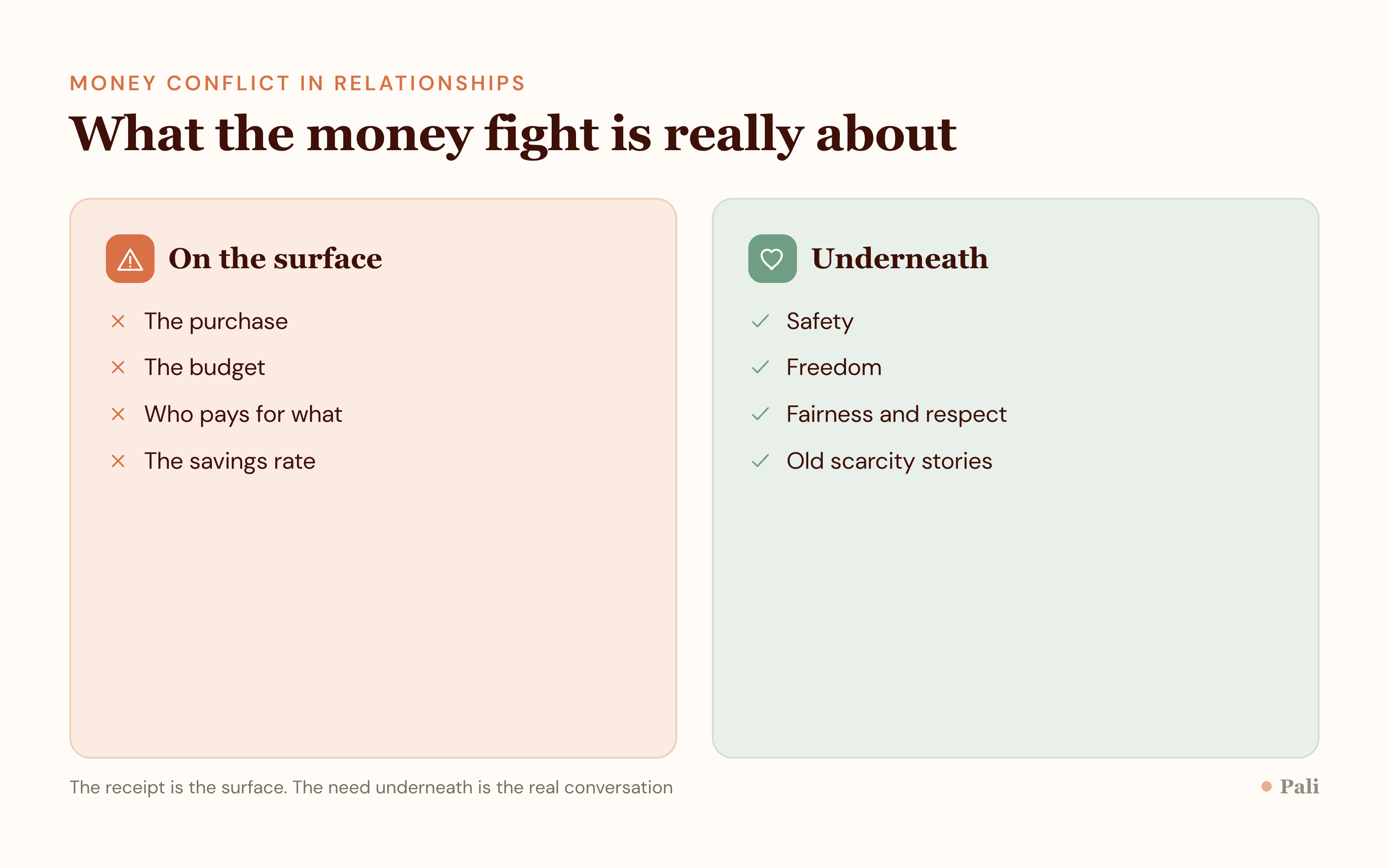
What is the money fight really about?
Often it is about money scripts, the beliefs you inherited about money long before you met your partner. One of you may have learned that money means security and should be saved. The other may have learned it means freedom and should be enjoyed. Neither is wrong, but unspoken, they collide.
This is the same dynamic behind most recurring arguments, where the topic is a doorway to a deeper need. If money is your repeating loop, it helps to read it alongside why you fight about the same things, because the exit is the same: understand the need, not just the number.
How do you talk about money without fighting?
Structure helps, because it lowers the heat. Try a calm, scheduled money conversation rather than an ambush in the moment.
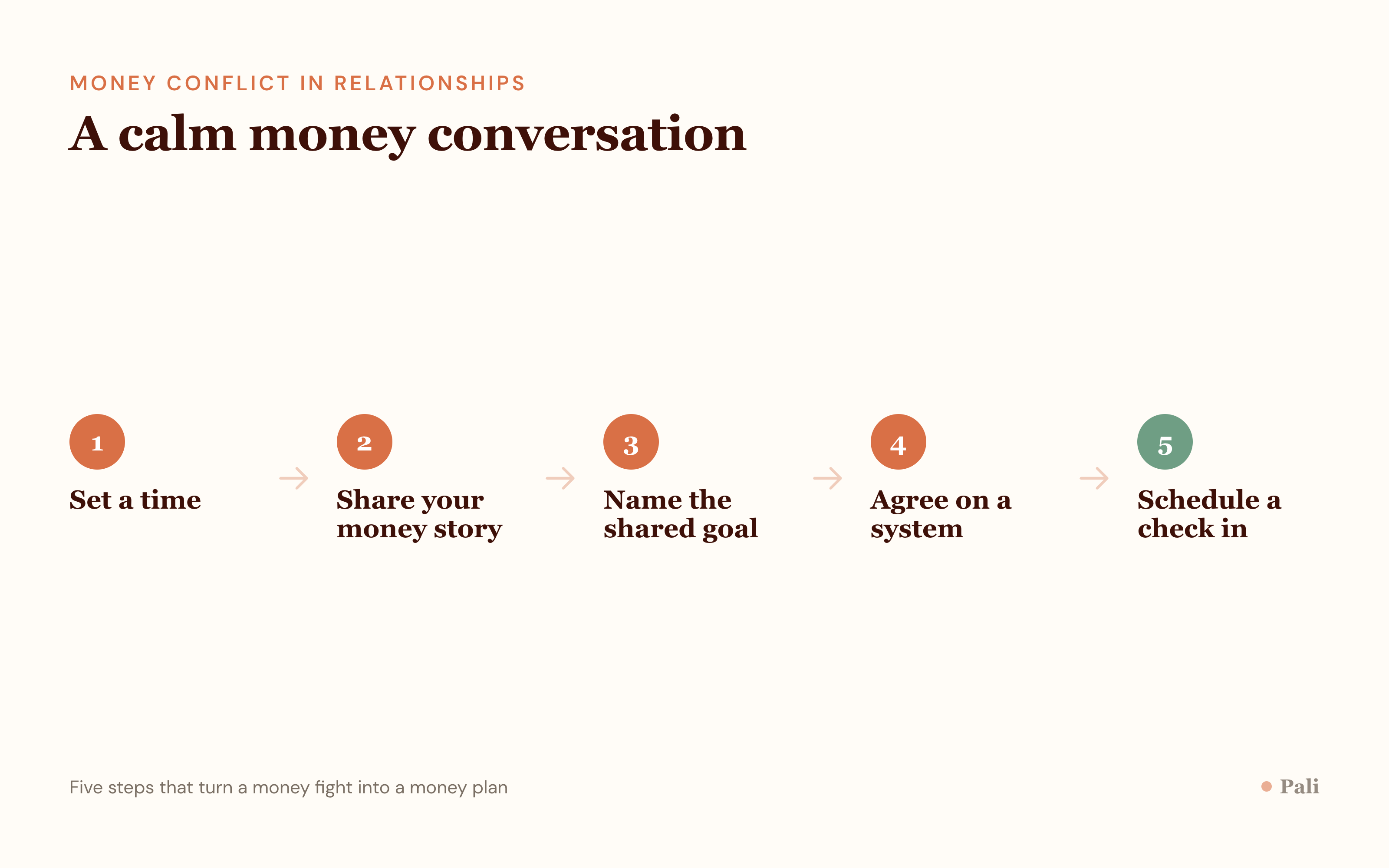
- Set a time. Money talks go better scheduled and unhurried than sprung mid stress.
- Share your money story. Tell each other what money meant in the home you grew up in. Understanding the script softens the judgement.
- Name the shared goal. Aim at the same target together rather than defending opposite corners.
- Agree on a system. Decide how you split, save, and spend, including some no questions money for each person.
- Schedule a check in. A short monthly review prevents small resentments from compounding.
Handled with care, money becomes a place you practise teamwork. That is really an exercise in healthy communication and the emotional intelligence to stay generous when the topic feels tight.
Frequently asked questions
Is fighting about money normal? Yes, it is one of the most common conflict topics for couples. What matters is whether you can discuss it with respect rather than blame, since the way you argue predicts more than the topic itself.
Should couples combine finances? There is no single right answer. Fully joint, fully separate, and hybrid systems can all work. What matters most is that both people feel the arrangement is fair and transparent.
Why does my partner and I have such different money habits? Usually because you learned different money scripts growing up. Naming those beliefs out loud turns a clash of habits into a conversation you can actually have.
How often should couples talk about money? A brief monthly check in works well for most couples. Regular small conversations prevent the big, heated ones that tend to erupt when money is avoided.
Pali is designed for self-improvement and educational support. It is not therapy and is not a substitute for professional mental health care.