
Losing Yourself in a Relationship: A Guide to Differentiation
Losing yourself in a relationship happens when staying connected starts to cost you your own preferences, friendships, and opinions. It usually is not weakness, it is an attempt to keep the peace or keep the bond safe. The healthier alternative is differentiation, the ability to stay fully yourself while staying close to someone else.
What does it mean to lose yourself in a relationship?
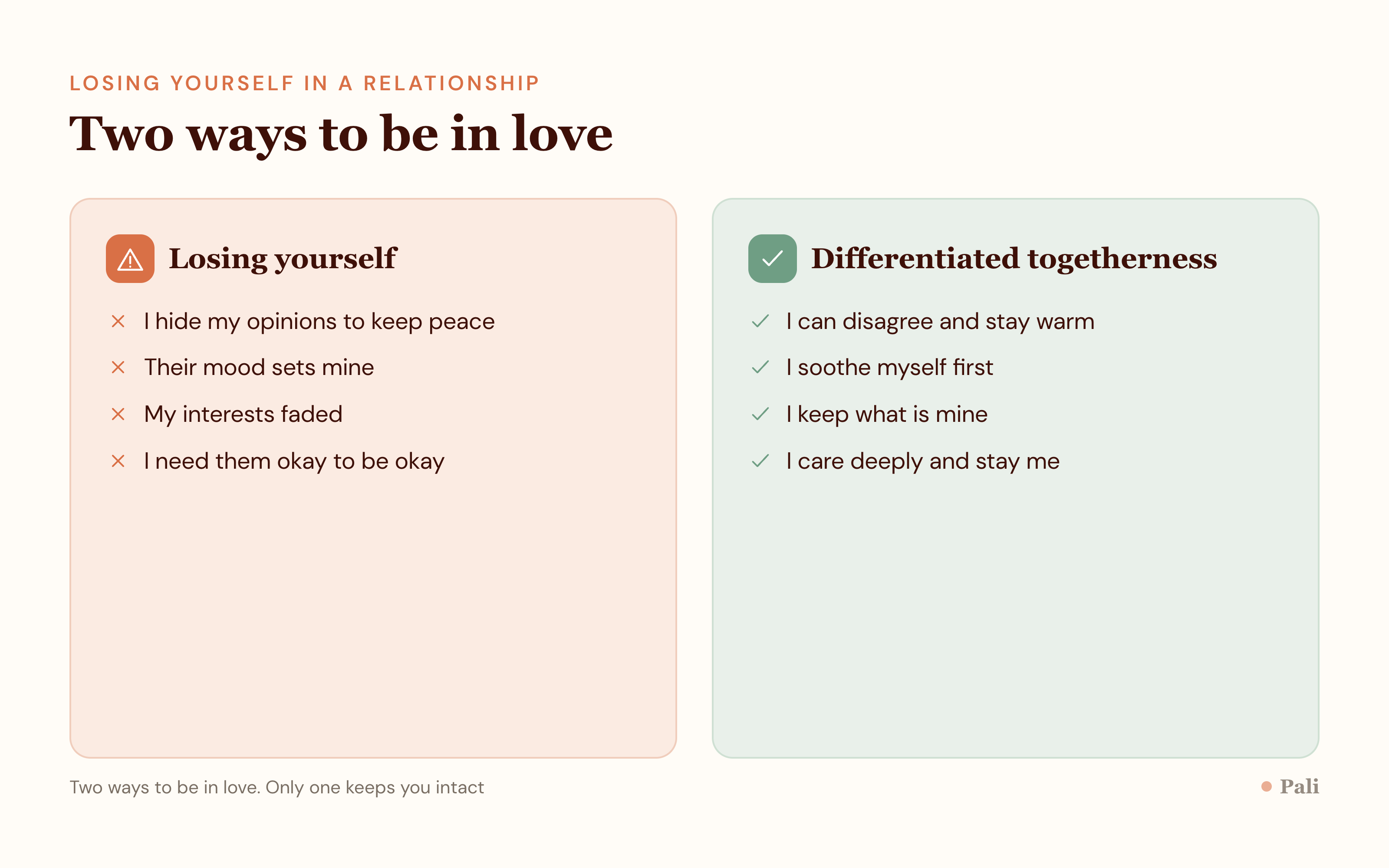
It means slowly trading your own shape for the relationship’s shape. Your hobbies fade. Your opinions soften to match theirs. You check their mood before you check your own. None of this is dramatic, which is why it is easy to miss until you wake up unsure what you actually want.
This often traces back to how you learned to stay connected as a child, which is the territory of your attachment style. If closeness once required becoming who others needed, merging can feel like love rather than loss.
What is differentiation?
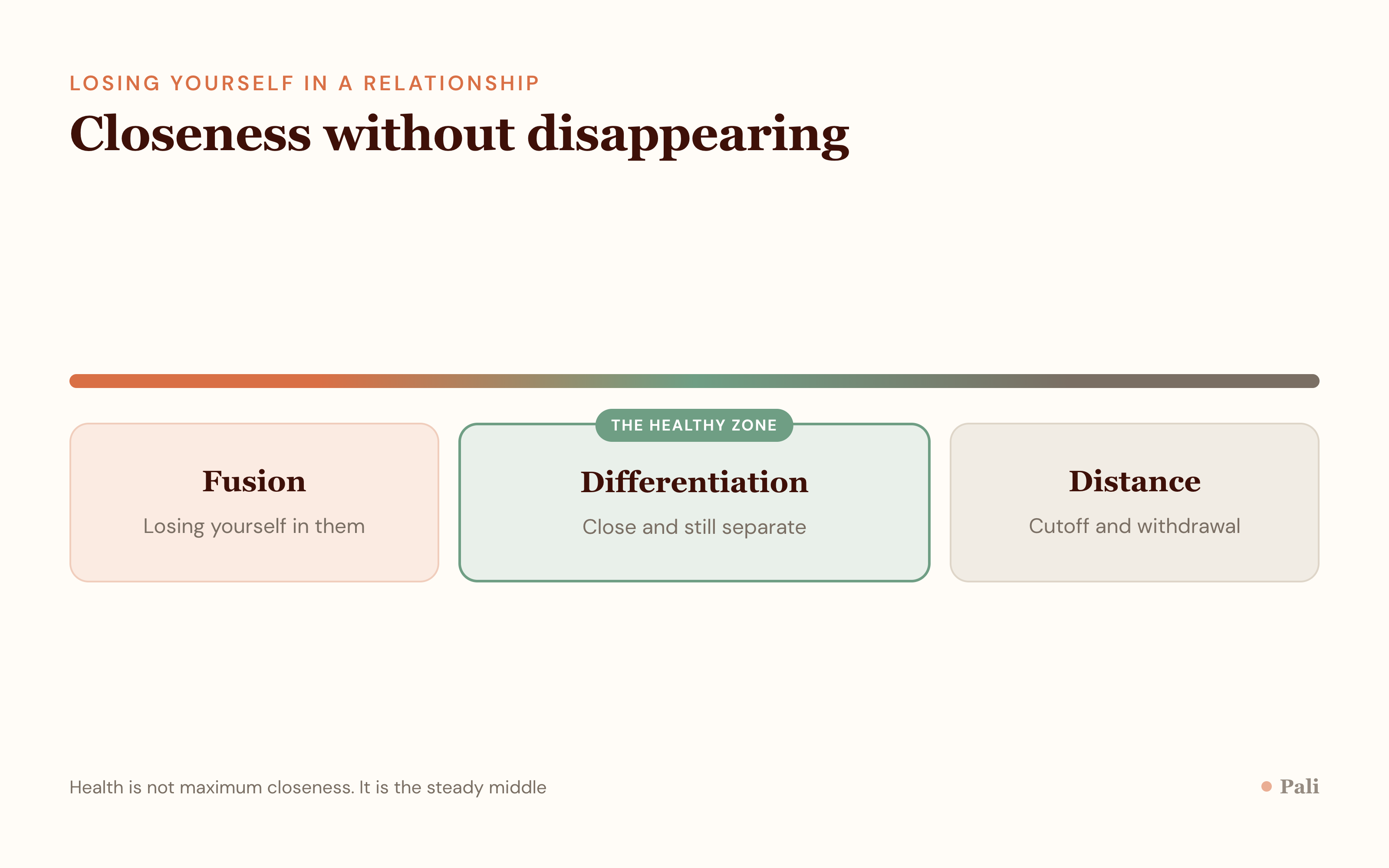
Differentiation is a concept developed by the psychiatrist Murray Bowen. In plain terms, it is the capacity to hold on to yourself while staying emotionally connected to people you love. A differentiated person can disagree without panicking, soothe their own feelings rather than outsourcing that job to a partner, and stay warm under pressure without abandoning their own position.
It is the opposite of two extremes. On one side is fusion, where you lose yourself to keep the bond. On the other is distance, where you protect yourself by pulling away. Differentiation is the steadier middle, close and separate at the same time.
How do you stay yourself without losing the relationship?
You build differentiation in small, repeatable choices, not one grand stand.
- Keep something that is just yours. A friendship, a practice, an interest the relationship does not absorb.
- Notice when you go quiet. If you swallow a preference to avoid friction, that is the moment to gently speak it.
- Self soothe before you seek reassurance. Calm your own nervous system first, then connect, rather than handing your partner the whole job.
- Tolerate a little discomfort. Staying yourself sometimes means a partner is briefly disappointed. That is survivable, and it is part of healthy communication.
Staying separate without going cold is a skill, and it draws on the same emotional intelligence that lets you stay warm during disagreement. Closeness built on two whole people is sturdier than closeness built on one person disappearing.
Frequently asked questions
Is losing yourself in a relationship a red flag? It is a yellow flag worth attention. A little merging early on is common. A pattern of erasing your needs to keep someone happy tends to breed resentment and quiet loss of self.
What is the difference between differentiation and codependency? Codependency leans on fusion, where your wellbeing depends on managing the other person. Differentiation keeps your sense of self intact, so you can care deeply without losing your centre.
Can you be too independent in a relationship? Yes. Differentiation is not the same as distance. If staying yourself means never needing or leaning on anyone, that is the cutoff end of the spectrum, not health.
How do I rebuild myself after losing who I was? Start small. Reconnect with one interest, one friendship, and one honest opinion. Identity comes back through action, not through waiting to feel like yourself again.
Pali is designed for self-improvement and educational support. It is not therapy and is not a substitute for professional mental health care.