
The Anxious-Avoidant Trap in Relationships
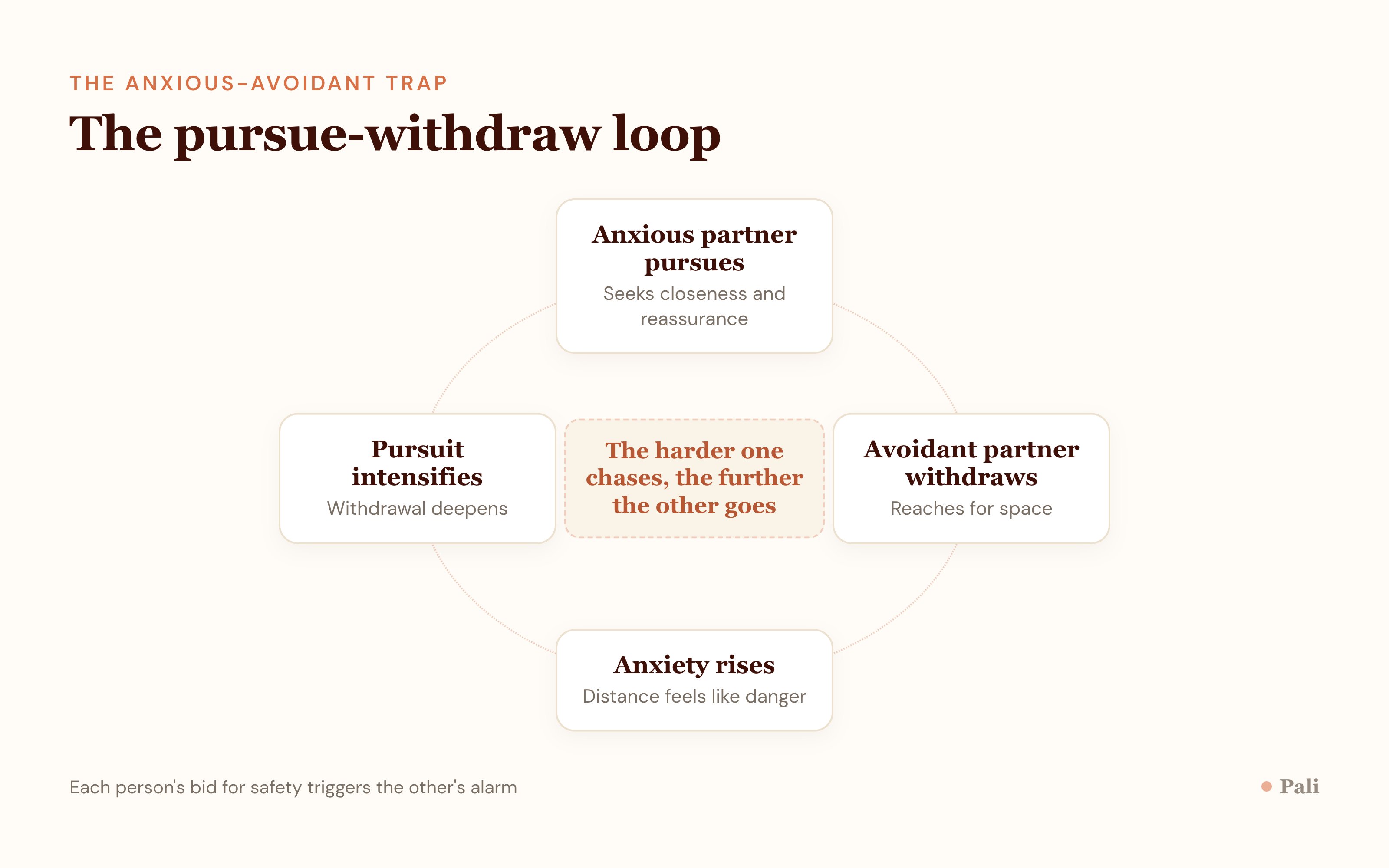
The anxious-avoidant trap is a push-pull cycle where one partner seeks closeness while the other seeks space, and each person’s coping makes the other’s fear worse. The anxious partner pursues to feel safe, which makes the avoidant partner withdraw to feel safe, which makes the anxious partner pursue harder. It is not that you are wrong for each other by nature. You are caught in a loop that feeds itself.
What is the anxious-avoidant cycle?
This pattern shows up when someone with anxious attachment pairs with someone who leans avoidant. Under stress, their protective strategies point in opposite directions. One moves toward connection to calm down. The other moves away from it to calm down.
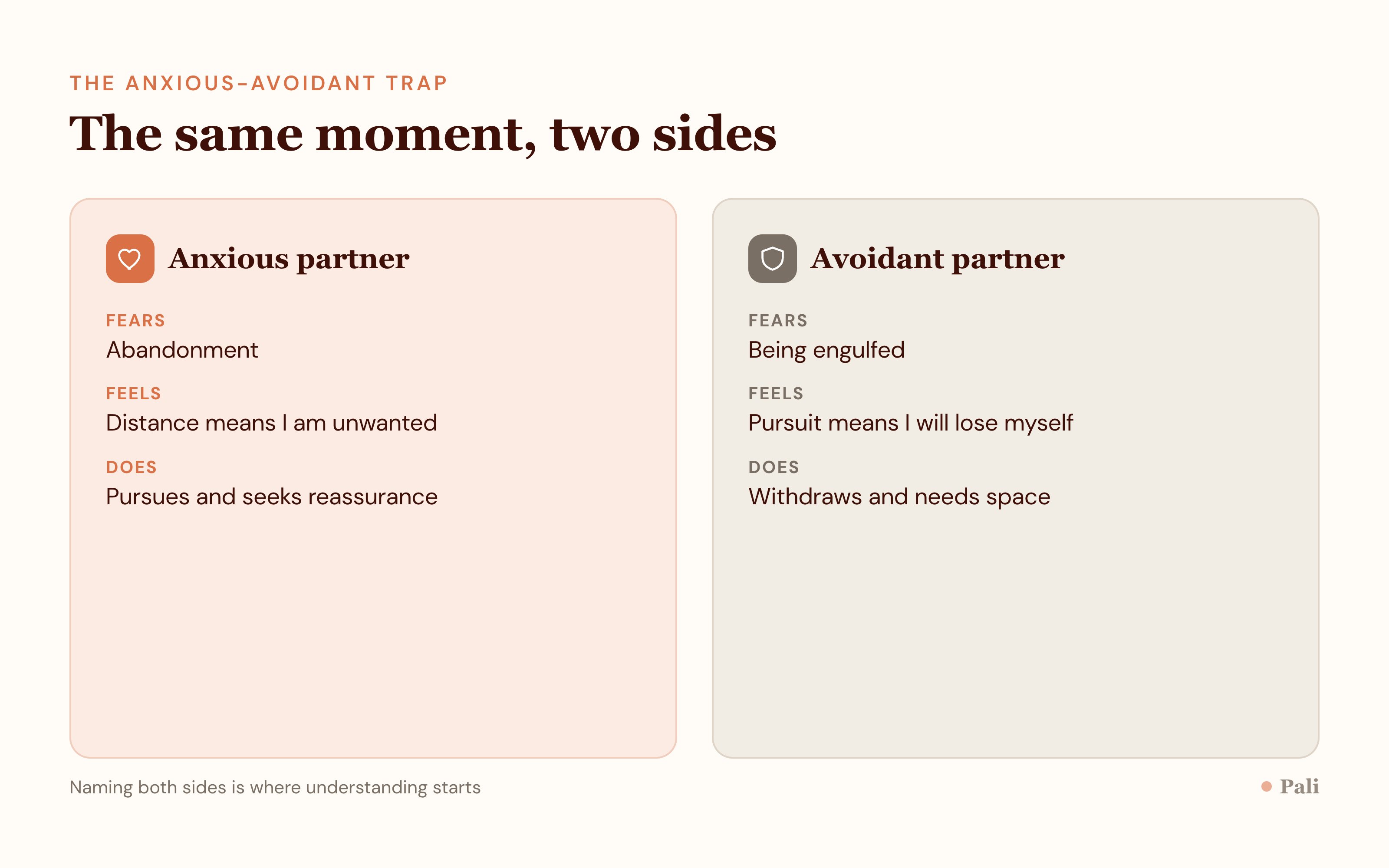
The painful part is that each move confirms the other’s deepest fear. The anxious partner fears abandonment, so distance feels like proof they are unwanted. The avoidant partner fears being engulfed, so pursuit feels like proof they will lose themselves. Both are trying to feel safe, and both end up more activated.
Why are anxious and avoidant people so drawn to each other?
There is often a real spark at the start, and it is not an accident. The avoidant person’s independence can feel calm and attractive to someone anxious. The anxious person’s warmth and pursuit can feel flattering and safe to someone avoidant. Each meets the other where they are comfortable, at first.
The trouble comes later, when the same traits that attracted you start to activate your fears. This is part of why people sometimes find themselves repeating it, explored more in why you keep attracting the wrong partners.
How do you break the anxious-avoidant trap?
The cycle breaks when at least one person changes their part of it, rather than waiting for the other to change first. A few starting points:
- See the cycle, not the villain. Name the pattern together as the shared problem, so neither person is the enemy.
- Anxious partner. Practise self-soothing before reaching for reassurance, so pursuit is a choice, not a reflex.
- Avoidant partner. Offer a small, clear signal before taking space, so distance does not read as disappearance.
- Both. Slow down in heated moments and regulate first, then talk. Emotional flooding keeps the loop alive.
- Move toward security. As each person builds steadier patterns, the cycle loses its fuel.
The most durable change is not managing the other person, it is becoming more secure yourself, which our guide on attachment styles lays out in full. Pali helps you start with yourself and understand your own side of the pattern, one small step at a time.
Can an anxious-avoidant relationship work?
Yes, it can, though it usually takes honesty and effort from both people. Many couples move from a painful push-pull toward something steadier as each partner grows more secure and learns to read the cycle in real time. The relationship does not have to stay a trap. It can become the place where both people heal, if both are willing to do their part.
Frequently asked questions
Why does the anxious-avoidant cycle feel so addictive? The intermittent closeness and distance creates an on-again pattern that can feel intense and hard to leave. The highs feel high precisely because the lows feel uncertain.
Who should change first in an anxious-avoidant relationship? Whoever is ready. The cycle is interactive, so a meaningful shift by either partner changes the dynamic. You do not have to wait for the other person to start.
Can two insecure partners become secure together? Yes. With awareness, regulation, and repair, both partners can move toward earned security, and a safe relationship can be part of that growth.
Is the anxious-avoidant trap a sign we are incompatible? Not necessarily. It is a common dynamic driven by attachment patterns, not proof of incompatibility. What matters is whether both people are willing to work on it.
Pali is designed for self-improvement and educational support. It is not therapy and is not a substitute for professional mental health care.