
Dating Red Flags vs Deal Breakers
A red flag is an early warning sign worth paying attention to. A deal breaker is a line you are not willing to cross, no matter how much you like someone. The skill in dating is not spotting flags, it is knowing which ones are worth a conversation and which ones mean it is time to walk away. Both protect you, but they ask for different responses.
What is the difference between a red flag and a deal breaker?
A red flag is information. It tells you to slow down and look closer, not necessarily to leave. People are complex, and some flags are about timing, nerves, or a bad day rather than character.
A deal breaker is a decision you have already made about your own life. It does not depend on how charming the person is. It is the value or need you will not compromise, because doing so would cost you yourself.
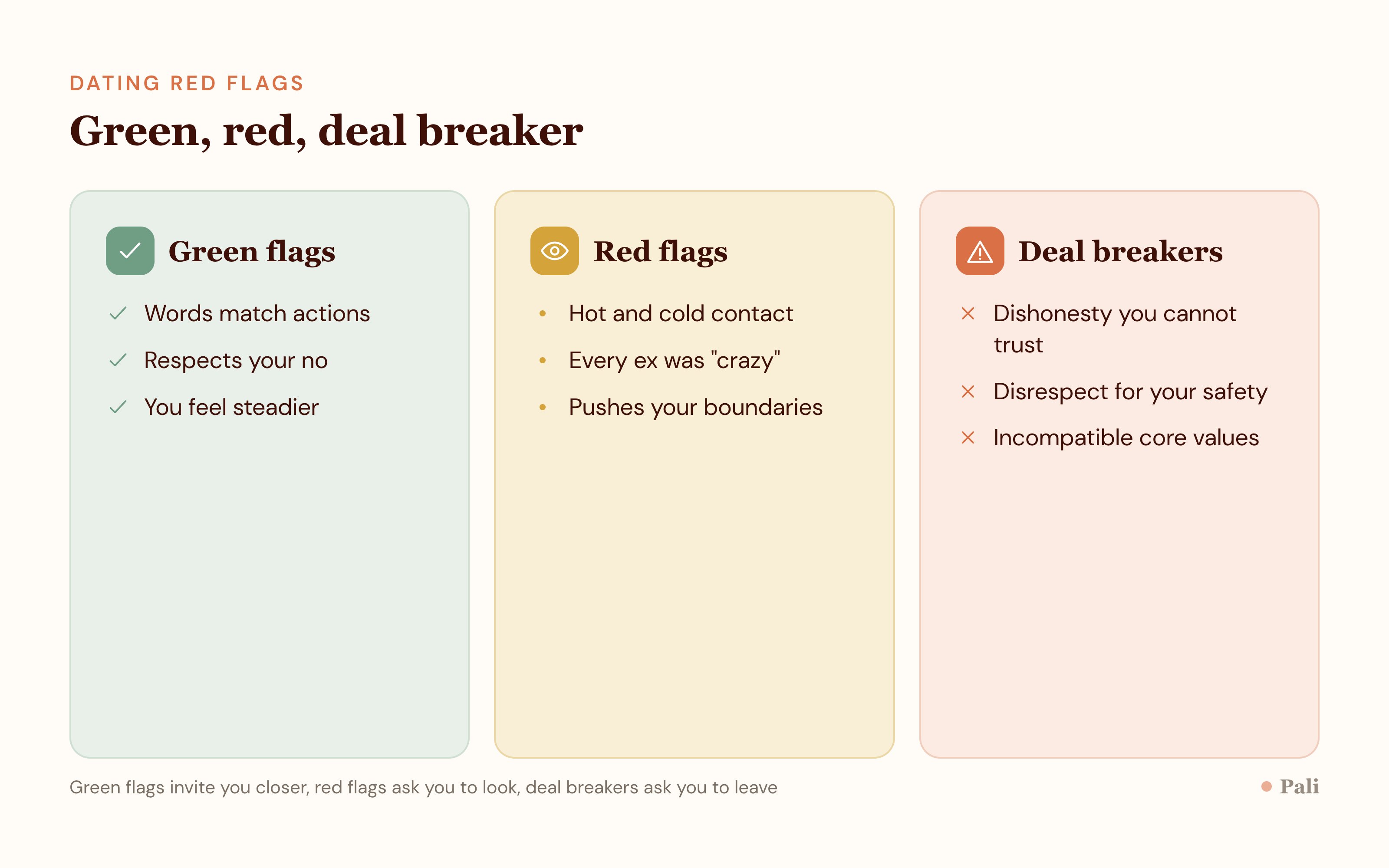
What are common dating red flags?
Red flags are patterns more than single moments. A few worth noticing early:
- They speak about every ex as crazy or entirely to blame.
- Their words and their actions do not match over time.
- They push past your stated boundaries, then call you sensitive.
- Communication runs hot and cold with no clear reason.
- You feel anxious or smaller after seeing them, not steadier.
Some of these overlap with signs you are emotionally unavailable, which is worth reading from both sides, since it helps you notice the pattern in a date and in yourself.
How do you tell a red flag from your own attachment fear?
This is the harder question, and an honest one. Sometimes what feels like a red flag is real. Sometimes it is your nervous system reacting to normal closeness or normal distance. If you tend to read silence as rejection or independence as a threat, your alarm may fire even when nothing is wrong.
A useful test is to ask whether the concern is about their behaviour or about your fear. Behaviour is observable and repeatable. Fear tends to be loud, fast, and focused on worst-case stories. Dating with self-awareness, the heart of dating with intention, means learning to tell the two apart before you react.
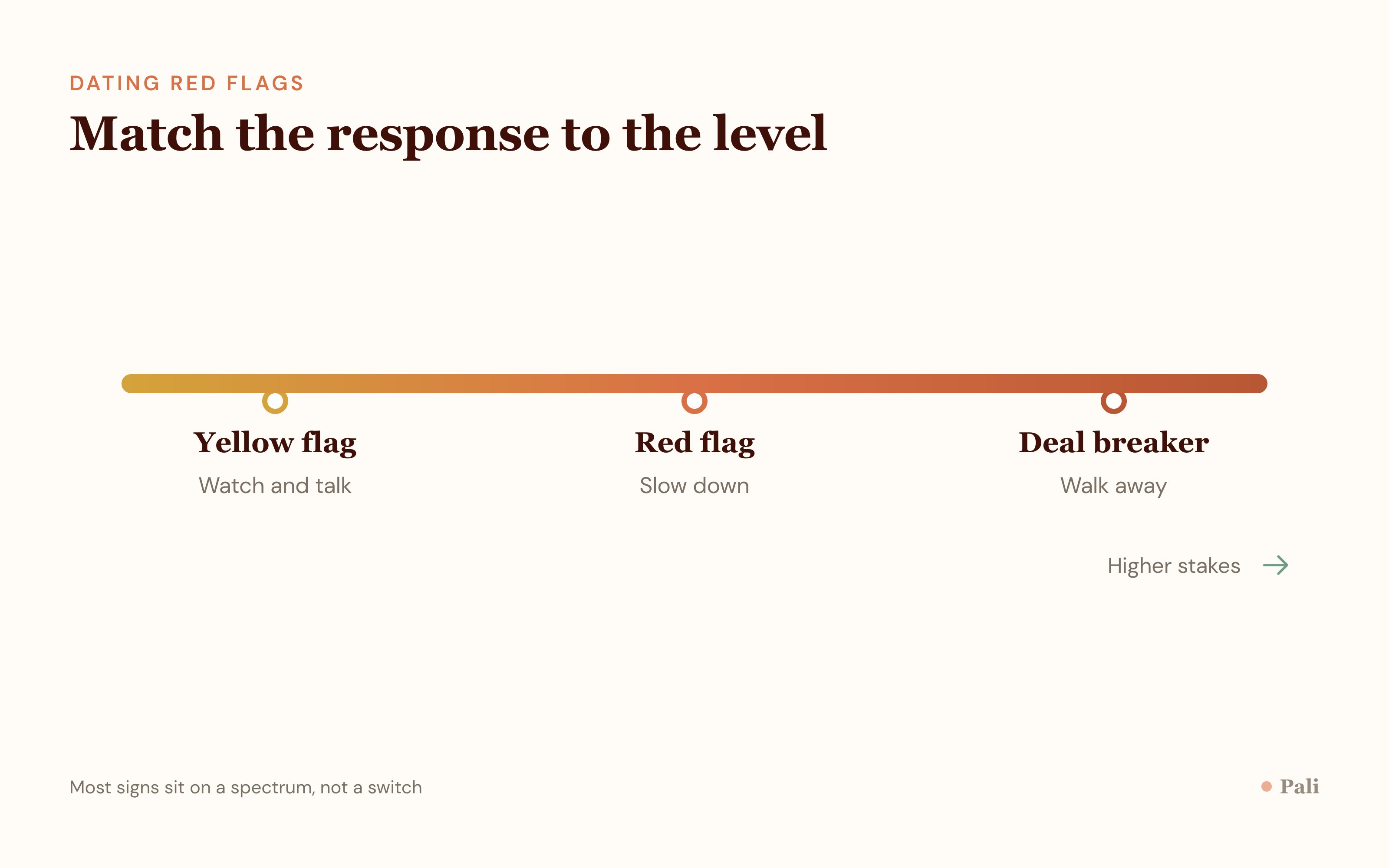
What should actually be a deal breaker?
Deal breakers are personal, but they tend to cluster around safety, values, and fundamental compatibility. Things like dishonesty you cannot trust around, disrespect for your boundaries, incompatible visions for your life, or anything that makes you feel unsafe. Naming yours in advance, before you are attached, is one of the kindest things you can do for your future self.
If you find you keep meeting the same flag in different people, it can be worth exploring why you keep attracting the wrong partners. Pali can help you get clear on your own non-negotiables so you date from steadiness rather than hope.
Frequently asked questions
Is every red flag a reason to end things? No. A red flag is a signal to slow down and pay attention. Some are workable with honest conversation, while others reveal a deal breaker underneath.
What is the difference between a red flag and a deal breaker? A red flag is an early warning sign that invites a closer look. A deal breaker is a fixed limit you will not cross regardless of how much you like the person.
Can my attachment style make me see red flags that are not there? Yes. Anxious or avoidant patterns can read normal closeness or distance as danger. Checking whether your concern is about behaviour or fear helps.
Should I tell someone about a red flag I noticed? If it is workable and you want to continue, naming it calmly is healthy. It also tells you a lot about how they respond to feedback.
Pali is designed for self-improvement and educational support. It is not therapy and is not a substitute for professional mental health care.